



All entities created in the United States — including those previously known as “domestic reporting companies” — and their beneficial owners are now exempt from the requirement to report beneficial ownership information (BOI) to the Financial Crimes Enforcement Network (FinCEN) under the Corporate Transparency Act (CTA).
FinCEN published an interim final rule on March 26, 2025, that revised the definition of “reporting company” in its regulations implementing the CTA to mean only those entities formed under the law of a foreign country that have registered to do business in any U.S. State or tribal jurisdiction by the filing of a document with a secretary of state or similar office (formerly known as “foreign reporting companies”). FinCEN also formally exempted entities previously known as “domestic reporting companies” from the CTA’s reporting requirements.
Reporting companies now also do not need to report the BOI of any U.S. persons, and U.S. persons are exempt from having to provide BOI with respect to any reporting company for which they are a beneficial owner.
Foreign entities that meet the new definition of a “reporting company” and do not qualify for an exemption from the reporting requirements are required to file with FinCEN under new deadlines:
- Reporting companies registered to do business in the United States before March 26, 2025, must file BOI reports by April 25, 2025.
- Reporting companies registered to do business in the United States on or after March 26, 2025, have 30 calendar days to file an initial BOI report after receiving notice that their registration is effective.
The guidance issued below has not yet been fully updated to account for this new interim final rule. Thus, any guidance here indicating that U.S companies, or their beneficial owners, must report BOI to FinCEN; that BOI must be reported for U.S. persons; or that reporting companies must report BOI before April 25, 2025, should be disregarded.
FinCEN has prepared the following Frequently Asked Questions (FAQs) in response to inquiries received relating to the Beneficial Ownership Information Reporting Rule and Beneficial Ownership Information Access and Safeguards Rule.
These FAQs are explanatory only and do not supplement or modify any obligations imposed by statute or regulation. Please refer to the Beneficial Ownership Information Reporting Rule and Beneficial Ownership Information Access and Safeguards Rule, available at www.fincen.gov/boi, for details on specific provisions. FinCEN expects to publish additional guidance in the future. Questions may be submitted on FinCEN’s Contact web page
Additional information about the interim final rule can be found on IFR: Questions and Answers
Read PDF versions of FAQs in English and other languages
A. General Questions
A. 1. What is beneficial ownership information?
A. 3. Under the Corporate Transparency Act, who can access beneficial ownership information?
A. 4. How will companies become aware of the BOI reporting requirements?
A. 5. How is an Indian Tribe defined under the Corporate Transparency Act?
B. Reporting Process
B. 1. Should my company report beneficial ownership information now?
B. 2. When do I need to report my company’s beneficial ownership information to FinCEN?
B. 3. When will FinCEN accept beneficial ownership information reports?
B. 4. Will there be a fee for submitting a beneficial ownership information report to FinCEN?
B. 5. How will I report my company’s beneficial ownership information?
B. 6. Where can I find the form to report?
B. 10. How do I report multiple beneficial owners or company applicants on one report?
C. Reporting Company
C. 1. What companies will be required to report beneficial ownership information to FinCEN?
C. 2. Are some companies exempt from the reporting requirement?
C. 5. Does the activity or revenue of a company determine whether it is a reporting company?
C. 6. Is a sole proprietorship a reporting company?
C. 7. Can a company created or registered in a U.S. territory be considered a reporting company?
C. 8. Do the BOI reporting requirements apply to S-Corporations?
C. 10. Are homeowners associations reporting companies?
C. 11. Are entities formed under Tribal law required to report beneficial ownership information?
D. Beneficial Owner
D. 1. Who is a beneficial owner of a reporting company?
D. 2. What is substantial control?
D. 4. What is an ownership interest?
D. 5. Who qualifies for an exception from the beneficial owner definition?
D. 6. Is my accountant or lawyer considered a beneficial owner?
D. 11. What should a reporting company report if its ownership is in dispute?
D. 13. Who is the beneficial owner of a homeowners association?
D. 14. Can beneficial owners own or control reporting companies through trusts?
D. 16. How does a reporting company report a corporate trustee as a beneficial owner?
E. Company Applicant
E. 1. Who is a company applicant of a reporting company?
E. 2. Which reporting companies are required to report company applicants?
E. 3. Is my accountant or lawyer considered a company applicant?
F. Reporting Requirements
F. 2. What information will a reporting company have to report about itself?
F. 3. What information will a reporting company have to report about its beneficial owners?
F. 4. What information will a reporting company have to report about its company applicants?
F. 5. What are acceptable forms of identification that will meet the reporting requirements?
F. 6. Is there a requirement to annually report beneficial ownership information?
F. 7. Does a reporting company have to report information about its parent or subsidiary companies?
F. 8. Can a reporting company report a P.O. box as its current address?
G. Initial Report
G. 1. When do I have to file an initial beneficial ownership information report with FinCEN?
G. 2. Can a parent company file a single BOI report on behalf of its group of companies?
H. Updated Report
H. 1. What should I do if previously reported information changes?
H. 2. What are some likely triggers for needing to update a beneficial ownership information report?
H. 5. Can a filer submit a late updated BOI report?
I. Corrected Report
I. 1. What should I do if I learn of an inaccuracy in a report?
J. Newly Exempt Entity Report
J. 1. What should a reporting company do if it becomes exempt after already filing a report?
K. Compliance/Enforcement
K. 2. What penalties do individuals face for violating BOI reporting requirements?
K. 3. Who can be held liable for violating BOI reporting requirements?
L. Reporting Company Exemptions
L. 5. How does a company report to FinCEN that the company is exempt?
M. FinCEN Identifier
M. 1. What is a FinCEN identifier?
M. 2. How can I use a FinCEN identifier?
M. 3. How do I request a FinCEN identifier?
M. 4. Are FinCEN identifiers required?
M. 5. Do I need to update or correct the information I submitted to obtain a FinCEN identifier?
M. 7. Who can request a FinCEN identifier on behalf of an individual?
N. Third-Party Service Providers
O. Access to Beneficial Ownership Information
O. 1. When will authorized recipients have access to beneficial ownership information?
O. 3. Which state agencies can request beneficial ownership information from FinCEN?
O. 4. Can foreign governments access beneficial ownership information?
A. General Questions
Beneficial ownership information refers to identifying information about the individuals who directly or indirectly own or control a company.
[Issued March 24, 2023]
In 2021, Congress passed the Corporate Transparency Act on a bipartisan basis. This law creates a new beneficial ownership information reporting requirement as part of the U.S. government’s efforts to make it harder for bad actors to hide or benefit from their ill-gotten gains through shell companies or other opaque ownership structures.
[Issued September 18, 2023]
In accordance with the Corporate Transparency Act, FinCEN may permit access to beneficial ownership information to:
- Federal agencies engaged in national security, intelligence, or law enforcement activity;
- State, local, and Tribal law enforcement agencies with court authorization;
- Officials at the Department of the Treasury;
- Foreign law enforcement agencies, judges, prosecutors, and other authorities that submit a request through a U.S. Federal agency to obtain beneficial ownership information for authorized activities related to national security, intelligence, and law enforcement;
- Financial institutions with customer due diligence requirements under applicable law (in order to facilitate compliance with those requirements); and
- Federal functional regulators or other appropriate regulatory agencies that supervise or assess financial institutions with access to beneficial ownership information (in order to supervise such financial institutions’ compliance with customer due diligence requirements).
FinCEN published the rule that will govern access to and protection of beneficial ownership information on December 22, 2023. Beneficial ownership information reported to FinCEN is stored in a secure, non-public database using rigorous information security methods and controls typically used in the Federal government to protect non-classified yet sensitive information systems at the highest security level. FinCEN will continue to work closely with those authorized to access beneficial ownership information to ensure that they understand their roles and responsibilities in using the reported information only for authorized purposes and handling in a way that protects its security and confidentiality.
[Updated October 3, 2024]
FinCEN is engaged in a robust outreach and education campaign to raise awareness of and help reporting companies understand the new reporting requirements. That campaign involves virtual and in-person outreach events and comprehensive guidance in a variety of formats and languages, including multimedia content and the Small Entity Compliance Guide, as well as new channels of communication, including social media platforms. FinCEN is also engaging with governmental offices at the federal and state levels, small business and trade associations, and interest groups.
FinCEN will continue to provide guidance, information, and updates related to the BOI reporting requirements on its BOI webpage, www.fincen.gov/boi. Subscribe here to receive updates via email from FinCEN about BOI reporting obligations.
[Issued December 12, 2023]
For purposes of reporting beneficial ownership information to FinCEN, “Indian Tribe” means any Indian or Alaska Native tribe, band, nation, pueblo, village, or community that the Secretary of the Interior acknowledges to exist as an Indian tribe. The Secretary of the Interior is required to publish annually a list of all recognized Indian Tribes in the Federal Register (https://www.federalregister.gov/documents/2024/01/08/2024-00109/indian-entities-recognized-by-and-eligible-to-receive-services-from-the-united-states-bureau-of).
[Updated June 10, 2024]
No. Beneficial ownership information reported to FinCEN is exempt from disclosure under the Freedom of Information Act (FOIA).
[Issued October 3, 2024]
B. Reporting Process
FinCEN launched the BOI E-Filing website for reporting beneficial ownership information (https://boiefiling.fincen.gov) on January 1, 2024.
- A reporting company created or registered to do business before January 1, 2024, will have until January 1, 2025, to file its initial BOI report.
- A reporting company created or registered in 2024 will have 90 calendar days to file after receiving actual or public notice that its creation or registration is effective.
- A reporting company created or registered on or after January 1, 2025, will have 30 calendar days to file after receiving actual or public notice that its creation or registration is effective.
[Updated January 4, 2024]
A reporting company created or registered to do business before January 1, 2024, will have until January 1, 2025 to file its initial beneficial ownership information report.
A reporting company created or registered on or after January 1, 2024, and before January 1, 2025, will have 90 calendar days after receiving notice of the company’s creation or registration to file its initial BOI report. This 90-calendar day deadline runs from the time the company receives actual notice that its creation or registration is effective, or after a secretary of state or similar office first provides public notice of its creation or registration, whichever is earlier.
Reporting companies created or registered on or after January 1, 2025, will have 30 calendar days from actual or public notice that the company’s creation or registration is effective to file their initial BOI reports with FinCEN.
[Updated December 1, 2023]
FinCEN will begin accepting beneficial ownership information reports on January 1, 2024. Beneficial ownership information reports will not be accepted before then.
[Issued March 24, 2023]
No. There is no fee for submitting your beneficial ownership information report to FinCEN.
[Updated January 4, 2024]
If you are required to report your company’s beneficial ownership information to FinCEN, you will do so electronically through a secure filing system available via FinCEN’s BOI E-Filing website (https://boiefiling.fincen.gov).
[Updated January 4, 2024]
Access the form by going to FinCEN’s BOI E-Filing website (https://boiefiling.fincen.gov) and select “File BOIR.”
[Updated January 4, 2024]
No. FinCEN expects that many, if not most, reporting companies will be able to submit their beneficial ownership information to FinCEN on their own using the guidance FinCEN has issued. Reporting companies that need help meeting their reporting obligations can consult with professional service providers, such as lawyers, accountants, or enrolled agents.
[Updated October 3, 2024]
Anyone a reporting company authorizes to act on its behalf—such as an employee, owner, or third-party service provider—may file a BOI report on the reporting company’s behalf. When submitting the BOI report, individual filers should be prepared to provide basic contact information about themselves, including their name and email address. The person filing the BOI report, including a third-party service provider, must certify on behalf of the reporting company that the information is true, correct, and complete. (See Question C.15 regarding who can file a BOI report for a reporting company that ceases to exist before its initial BOI report is due to FinCEN.)
[Updated October 3, 2024]
Nothing in the Corporate Transparency Act or FinCEN’s regulations prevents a third-party service provider who is not an attorney from submitting a reporting company’s beneficial ownership information (if authorized by the company to do so) or otherwise assisting a reporting company with preparing or submitting a BOI report. Whether an action qualifies as the unauthorized practice of law, however, is generally determined by state law, and thus may vary.
[Issued October 3, 2024]
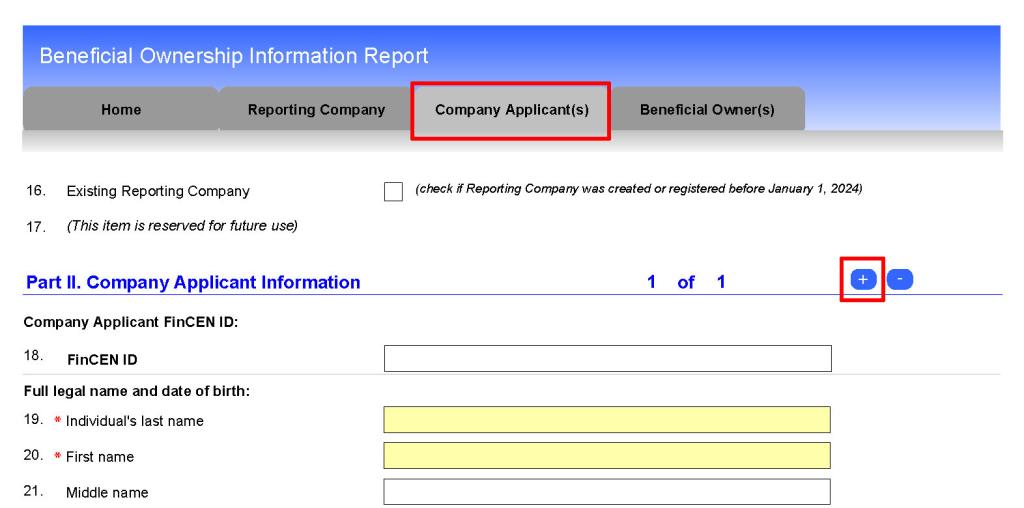
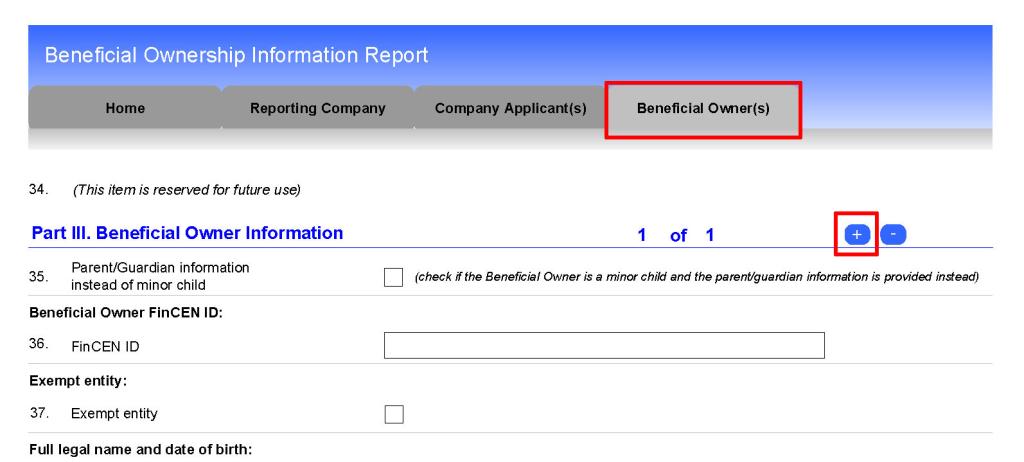
When completing the beneficial ownership information (BOI) report in a PDF, you can add company applicants or beneficial owners by using the “+” button next to the relevant Section title:
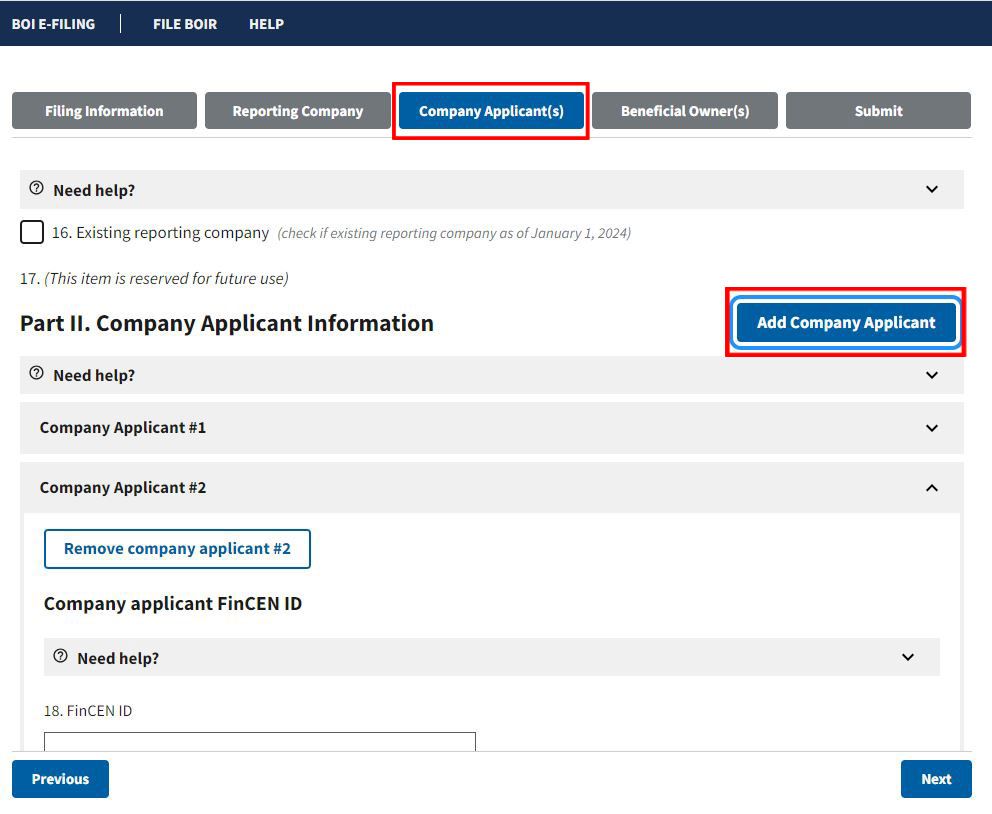
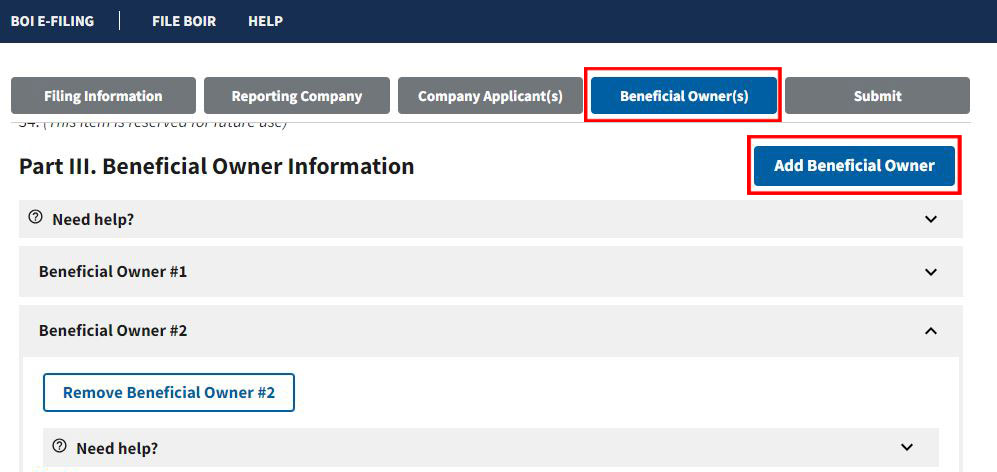
When completing the BOI report online rather than as a PDF, you can add company applicants or beneficial owners by using the “Add Company Applicant” or “Add Beneficial Owner” button in the relevant Section title:
[Issued October 3, 2024]
C. Reporting Company
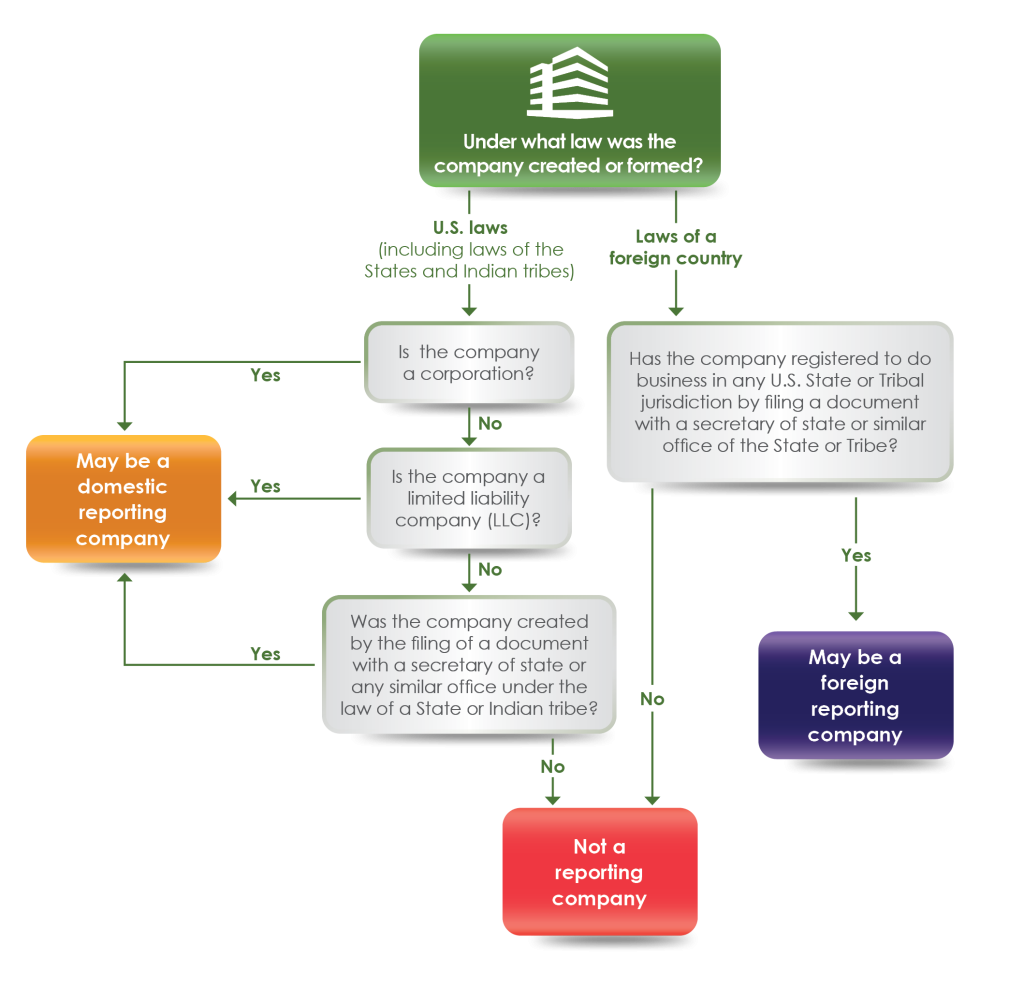
Companies required to report are called reporting companies. There are two types of reporting companies:
- Domestic reporting companies are corporations, limited liability companies, and any other entities created by the filing of a document with a secretary of state or any similar office in the United States.
- Foreign reporting companies are entities (including corporations and limited liability companies) formed under the law of a foreign country that have registered to do business in the United States by the filing of a document with a secretary of state or any similar office.
There are 23 types of entities that are exempt from the reporting requirements (see Question C.2). Carefully review the qualifying criteria before concluding that your company is exempt.
FinCEN’s Small Entity Compliance Guide for beneficial ownership information reporting includes the following flowchart to help identify if a company is a reporting company (see Chapter 1.1, “Is my company a “reporting company”?”).
[Issued September 18, 2023]
Yes, 23 types of entities are exempt from the beneficial ownership information reporting requirements. These entities include publicly traded companies meeting specified requirements, many nonprofits, and certain large operating companies.
The following table summarizes the 23 exemptions:
| Exemption No. | Exemption Short Title |
|---|---|
| 1 | Securities reporting issuer |
| 2 | Governmental authority |
| 3 | Bank |
| 4 | Credit union |
| 5 | Depository institution holding company |
| 6 | Money services business |
| 7 | Broker or dealer in securities |
| 8 | Securities exchange or clearing agency |
| 9 | Other Exchange Act registered entity |
| 10 | Investment company or investment adviser |
| 11 | Venture capital fund adviser |
| 12 | Insurance company |
| 13 | State-licensed insurance producer |
| 14 | Commodity Exchange Act registered entity |
| 15 | Accounting firm |
| 16 | Public utility |
| 17 | Financial market utility |
| 18 | Pooled investment vehicle |
| 19 | Tax-exempt entity |
| 20 | Entity assisting a tax-exempt entity |
| 21 | Large operating company |
| 22 | Subsidiary of certain exempt entities |
| 23 | Inactive entity |
FinCEN’s Small Entity Compliance Guide includes this table and checklists for each of the 23 exemptions that may help determine whether a company meets an exemption (see Chapter 1.2, “Is my company exempt from the reporting requirements?”). Companies should carefully review the qualifying criteria before concluding that they are exempt. Please see additional FAQs about reporting company exemptions in “L. Reporting Company Exemptions” below.
[Issued September 18, 2023]
It depends. A domestic entity such as a statutory trust, business trust, or foundation is a reporting company only if it was created by the filing of a document with a secretary of state or similar office. Likewise, a foreign entity is a reporting company only if it filed a document with a secretary of state or a similar office to register to do business in the United States.
State laws vary on whether certain entity types, such as trusts, require the filing of a document with the secretary of state or similar office to be created or registered.
- If a trust is created in a U.S. jurisdiction that requires such filing, then it is a reporting company, unless an exemption applies.
Similarly, not all states require foreign entities to register by filing a document with a secretary of state or a similar office to do business in the state.
- However, if a foreign entity has to file a document with a secretary of state or a similar office to register to do business in a state, and does so, it is a reporting company, unless an exemption applies.
Entities should also consider if any exemptions to the reporting requirements apply to them. For example, a foundation may not be required to report beneficial ownership information to FinCEN if the foundation qualifies for the tax-exempt entity exemption.
Chapter 1 of FinCEN’s Small Entity Compliance Guide (“Does my company have to report its beneficial owners?”) may assist companies in identifying whether they need to report.
[Issued November 16, 2023]
No. The registration of a trust with a court of law merely to establish the court’s jurisdiction over any disputes involving the trust does not make the trust a reporting company.
[Issued November 16, 2023]
Sometimes. A reporting company is (1) any corporation, limited liability company, or other similar entity that was created in the United States by the filing of a document with a secretary of state or similar office (in which case it is a domestic reporting company), or any legal entity that has been registered to do business in the United States by the filing of a document with a secretary of state or similar office (in which case it is a foreign reporting company), that (2) does not qualify for any of the exemptions provided under the Corporate Transparency Act. An entity’s activities and revenue, along with other factors in some cases, can qualify it for one of those exemptions. For example, there is an exemption for certain inactive entities, and another for any company that reported more than $5 million in gross receipts or sales in the previous year and satisfies other exemption criteria. Neither engaging solely in passive activities like holding rental properties, for example, nor being unprofitable necessarily exempts an entity from the BOI reporting requirements.
FinCEN’s Small Entity Compliance Guide provides additional information concerning exemptions in Chapter 1.2, “Is my company exempt from the reporting requirements?”
[Issued December 12, 2023]
No, unless a sole proprietorship was created (or, if a foreign sole proprietorship, registered to do business) in the United States by filing a document with a secretary of state or similar office. An entity is a reporting company only if it was created (or, if a foreign company, registered to do business) in the United States by filing such a document. Filing a document with a government agency to obtain (1) an IRS employer identification number, (2) a fictitious business name, or (3) a professional or occupational license does not create a new entity, and therefore does not make a sole proprietorship filing such a document a reporting company.
[Issued December 12, 2023]
Yes. In addition to companies in the 50 states and the District of Columbia, a company that is created or registered to do business by the filing of a document with a U.S. territory’s secretary of state or similar office, and that does not qualify for any exemptions to the reporting requirements, is required to report beneficial ownership information to FinCEN. U.S. territories are the Commonwealth of Puerto Rico, the Commonwealth of the Northern Mariana Islands, American Samoa, Guam, and the U.S. Virgin Islands.
[Issued January 12, 2024]
Yes. A corporation treated as a pass-through entity under Subchapter S of the Internal Revenue Code (an “S Corporation” or “S-Corp”) that qualifies as a reporting company—i.e., that is created or registered to do business by the filing of a document with a secretary of state or similar office, and does not qualify for any of the exemptions to the reporting requirements—must comply with the reporting requirements. The S-Corp’s pass-through structure for tax purposes does not affect its BOI reporting obligations. In particular, pass-through treatment under Subchapter S does not qualify an S-Corp as a “tax-exempt entity” under FinCEN BOI reporting regulations.
[Issued April 18, 2024]
No. While FinCEN’s BOI reporting regulations define a domestic reporting company as including a corporation or limited liability company, the inclusion of those entities is based on an understanding that domestic corporations and LLCs are generally created by the filing of a document with a secretary of state or similar office. In an unusual circumstance where a domestic corporation or limited liability company is created, but not by the filing of a document with a secretary of state or similar office, such an entity is not a reporting company.
[Issued April 18, 2024]
It depends. Homeowners associations (HOAs) can take different forms. As with any entity, if an HOA was not created by the filing of a document with a secretary of state or similar office, then it is not a domestic reporting company. An incorporated HOA or other HOA that was created by such a filing also may qualify for an exemption from the reporting requirements. For example, HOAs recognized by the IRS as section 501(c)(4) social welfare organizations (or that claim such status and meet the requirements) may qualify for the tax-exempt entity exemption. An incorporated HOA that is not a section 501(c)(4) organization, however, may fall within the reporting company definition and therefore be required to report BOI to FinCEN.
[Updated June 10, 2024]
Yes, if the entity meets the reporting company definition and does not qualify for any exemptions to the reporting requirements. See Question C.1 for more information on what entities are reporting companies.
While Indian Tribes have varying legal entity formation practices, some allow individuals to form legal entities such as corporations or LLCs under Tribal law by the filing of a document (such as Articles of Incorporation) with a Tribal office or agency whose routine functions include creating such entities pursuant to such filings. Tribal offices or agencies that perform this function may be called something other than a “secretary of state,” but they are performing a function similar to that of a typical secretary of state’s office. As a result, a legal entity created by a filing with such Tribal office or agency is a reporting company and is required to file beneficial ownership information with FinCEN, unless it qualifies for an exemption.
Note that, under the Corporate Transparency Act, a legal entity is a reporting company only if it is created or registered to do business “under the laws of a State or Indian Tribe.” Tribal corporations formed under federal law through the issuance of a charter of incorporation by the Secretary of the Interior—such as those created under section 3 of the Oklahoma Indian Welfare Act (25 U.S.C. 5203), or section 17 of the Indian Reorganization Act of 1934 (25 U.S.C. 5124)—are not created by the filing of a document with a secretary of state or similar office under the laws of an Indian tribe, and are therefore not reporting companies required to report beneficial ownership information to FinCEN.
Note also that “governmental authorities” are not required to report beneficial ownership information to FinCEN. For this purpose, a “governmental authority” is an entity that is (1) established under the laws of the United States, an Indian Tribe, a State, or a political subdivision of a State, or under an interstate compact between two or more States, and that (2) exercises governmental authority on behalf of the United States or any such Indian Tribe, State, or political subdivision. Thus, a Tribal entity that is such a “governmental authority” is not required to report beneficial ownership information to FinCEN. This category includes tribally chartered corporations and state-chartered Tribal entities, if those corporations or entities exercise governmental authority on a Tribe’s behalf.
Certain subsidiaries of governmental authorities are also exempt from the requirement to report beneficial ownership information to FinCEN. An entity qualifies for this exemption if its ownership interests are controlled (in their entirety) or wholly owned, directly or indirectly, by a governmental authority. Thus, for example, if a tribally chartered corporation (or state-chartered Tribal entity) exercises governmental authority on a Tribe’s behalf, and that tribally chartered corporation (or state-chartered Tribal entity) controls or wholly owns the ownership interests of another entity, then both the tribally chartered corporation (or state-chartered Tribal entity) and that subsidiary entity are exempt from the requirement to report beneficial ownership information to FinCEN. See Questions L.3 and L.6 for more information on this “subsidiary exemption.”
Other exemptions to the reporting requirements, such as the exemption for “tax-exempt entities,” may also apply to certain entities formed under Tribal law.
FinCEN’s Small Entity Compliance Guide includes a table and checklists for each of the 23 exemptions that may help determine whether a company meets an exemption (see Chapter 1.2, “Is my company exempt from the reporting requirements?”). Companies should carefully review the qualifying criteria before concluding that they are exempt. Please see additional FAQs about reporting company exemptions in “L. Reporting Company Exemptions” below.
[Issued June 10, 2024]
Yes. Beneficial ownership information reporting requirements apply to all companies that qualify as “reporting companies” (see Question C.1), regardless of when they were created or registered. Companies are not required to report beneficial ownership information to FinCEN if they are exempt (see Question C.2 and, generally, Section L) or ceased to exist as legal entities before January 1, 2024 (see Question C.13).
[Issued July 8, 2024]
A company is not required to report its beneficial ownership information to FinCEN if it ceased to exist as a legal entity before January 1, 2024, meaning that it entirely completed the process of formally and irrevocably dissolving. A company that ceased to exist as a legal entity before the beneficial ownership information reporting requirements became effective January 1, 2024, was never subject to the reporting requirements and thus is not required to report its beneficial ownership information to FinCEN.
Although state or Tribal law may vary, a company typically completes the process of formally and irrevocably dissolving by, for example, filing dissolution paperwork with its jurisdiction of creation or registration, receiving written confirmation of dissolution, paying related taxes or fees, ceasing to conduct any business, and winding up its affairs (e.g., fully liquidating itself and closing all bank accounts).
If a reporting company (see Question C.1) continued to exist as a legal entity for any period of time on or after January 1, 2024 (i.e., did not entirely complete the process of formally and irrevocably dissolving before January 1, 2024), then it is required to report its beneficial ownership information to FinCEN, even if the company had wound up its affairs and ceased conducting business before January 1, 2024.
Similarly, if a reporting company was created or registered on or after January 1, 2024, and subsequently ceased to exist, then it is required to report its beneficial ownership information to FinCEN—even if it ceased to exist before its initial beneficial ownership information report was due.
For specifics on how to determine when a company ceases to exist as a legal entity, consult the law of the jurisdiction in which the company was created or registered. A company that is administratively dissolved or suspended—because, for example, it failed to pay a filing fee or comply with certain jurisdictional requirements—generally does not cease to exist as a legal entity unless the dissolution or suspension becomes permanent.
[Issued July 8, 2024]
Yes. Reporting companies created or registered in 2024, no matter how quickly they cease to exist thereafter, must report their beneficial ownership information to FinCEN within 90 days of receiving actual or public notice of creation or registration. Reporting companies created or registered in 2025 or later, no matter how quickly they cease to exist thereafter, must report their beneficial ownership information to FinCEN within 30 days of receiving actual or public notice of creation or registration. These obligations remain applicable to reporting companies that cease to exist as legal entities—meaning wound up their affairs, ceased conducting business, and entirely completed the process of formally and irrevocably dissolving—before the expiration of the 30- or 90-day period reporting companies have to report their beneficial ownership information to FinCEN. If a reporting company files an initial beneficial ownership information report and then ceases to exist before the expiration of the 30- or 90-day period reporting companies have to report their beneficial ownership information to FinCEN, then there is no requirement for the reporting company to file an additional report with FinCEN noting that the company has ceased to exist.
[Updated September 10, 2024]
Anyone whom a reporting company authorizes to act on its behalf—such as an employee, owner, or third-party service provider—may file a BOI report on the reporting company’s behalf, even after the reporting company ceases to exist (see Question B.8). Thus, if a reporting company will cease to exist before the expiration of the 30- or 90-day period reporting companies have to report their beneficial ownership information to FinCEN, then it should make arrangements while it exists to have the report submitted on its behalf, even if the requisite filing does not occur until after the reporting company ceases to exist. Regardless, the BOI report must be filed by the time such report is due to FinCEN (see Question C.14).
[Issued September 10, 2024]
A foreign company is not required to report its beneficial ownership information to FinCEN if it ceased to be registered to do business in the United States before January 1, 2024. For purposes of complying with beneficial ownership information reporting requirements under the CTA, a foreign reporting company ceases to be registered to do business in the United States when it entirely completes the process of formally and irrevocably withdrawing its registration(s) to do business in the United States. A foreign company that entirely withdrew any and all registrations to do business in the United States before the beneficial ownership information reporting requirements became effective January 1, 2024, was never subject to the reporting requirements and thus is not required to report its beneficial ownership information to FinCEN.
Although state or Tribal law may vary, a foreign company typically completes the process of formally and irrevocably withdrawing its registration to do business in a jurisdiction by, for example, filing withdrawal paperwork with its jurisdiction of registration, receiving written confirmation of withdrawal, paying related taxes or fees, ceasing to conduct any business in the jurisdiction, and winding up its affairs in that jurisdiction.
If a foreign reporting company (see Question C.1) was registered to do business in the United States on or after January 1, 2024 for any period of time (i.e., the company did not entirely complete the process of withdrawing its registration before January 1, 2024), then it is required to report its beneficial ownership information to FinCEN, even if the company had wound up its affairs and ceased conducting business before January 1, 2024.
Similarly, if a foreign reporting company was registered to do business in the United States on or after January 1, 2024, for any period of time, and subsequently withdrew that registration, then the company is required to report its beneficial ownership information to FinCEN—even if it withdrew the registration before the expiration of the 30- or 90-day period reporting companies have to report their beneficial ownership information to FinCEN.
For specifics on how to determine when a company withdraws its registration to do business, consult the law of the jurisdiction in which the company was registered. A company that is administratively suspended from conducting business—because, for example, it failed to pay a filing fee or comply with certain jurisdictional requirements—generally does not cease to be registered to conduct business unless the suspension becomes permanent.
[Issued September 10, 2024]
A “similar office” is any office (including a department, agency, or bureau) of a governmental authority under the law of a State or Indian Tribe where or through which a domestic entity files a document to be created or a foreign entity files a document to be registered to do business in the United States. Federal agencies are not “similar offices.”
Domestic entities that are created by State or Federal charter are not created by the filing of a document with a secretary of state or similar office.
[Issued October 3, 2024]
A domestic reporting company is an entity “created by” the filing of a document with a secretary of state or any similar office under the law of a State or Indian Tribe.
Depending on the law of the State or Indian Tribe, and the type of entity undergoing a conversion, a conversion filing may result in the creation of a “new” domestic reporting company. Where a conversion does result in the creation of a new domestic reporting company, the new domestic reporting company is required to file an initial beneficial ownership information (BOI) report.
Even if a conversion filing does not create a new domestic reporting company, a reporting company that undergoes such a conversion may nonetheless be required to submit an updated BOI report to FinCEN after the conversion. For example, if “Company, Inc.” converted to an LLC, its name may have changed to “Company, LLC,” and thus it may be required to file an updated BOI report because the name change is a change to required information previously submitted to FinCEN.
Reporting companies are also required to report their jurisdiction of formation. This is the jurisdiction where the reporting company was originally created. If a reporting company changes its jurisdiction of formation (for example, by ceasing to be a corporation incorporated under California law and becoming instead a corporation incorporated under Texas law), it must submit an updated BOI report to FinCEN.
[Issued October 3, 2024]
No. Reporting companies must file initial beneficial ownership information (BOI) reports within certain timeframes. For example, a reporting company created (if domestic) or registered to do business (if foreign) in the United States on or after January 1, 2024, must file an initial BOI report after it has received actual notice that its creation or registration has become effective or the date on which a secretary of state or similar office first provides public notice, such as through a publicly accessible registry, that the reporting company has been created or registered.
A reporting company does not need to file additional BOI reports in connection with subsequent filings with secretaries of state or similar offices that merely:
(1) authorize a domestic reporting company that already exists under the laws of one State or Tribe to do business under the laws of another State or Tribe; or
(2) authorize a foreign reporting company that is already registered under the laws of one State or Tribe to do business under the laws of another State or Tribe.
[Issued October 3, 2024]
D. Beneficial Owner
A beneficial owner is an individual who either directly or indirectly: (1) exercises substantial control (see Question D.2) over the reporting company, or (2) owns or controls at least 25% of the reporting company’s ownership interests (see Question D.4). Because beneficial owners must be individuals (i.e., natural persons), trusts, corporations, or other legal entities are not considered to be beneficial owners. However, in specific circumstances, information about an entity may be reported in lieu of information about a beneficial owner (see Question D.12).
FinCEN’s Small Entity Compliance Guide provides checklists and examples that may assist in identifying beneficial owners (see Chapter 2.3 “What steps can I take to identify my company’s beneficial owners?”).
[Updated April 18, 2024]
How many beneficial owners can a reporting company have?
An individual might be a beneficial owner through substantial control, ownership interests, or both. A reporting company can have multiple beneficial owners; there is no maximum number of beneficial owners who must be reported.
[Issued October 3, 2024]
What if a reporting company does not have any individuals who own or control at least 25 percent?
FinCEN expects that every reporting company will be substantially controlled by one or more individuals, and therefore that every reporting company will be able to identify and report at least one beneficial owner to FinCEN.
[Issued October 3, 2024]
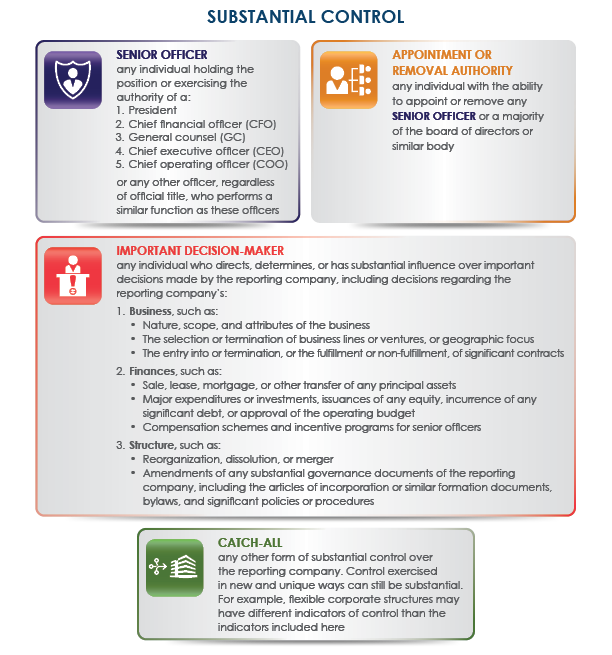
An individual can exercise substantial control over a reporting company in four different ways. If the individual falls into any of the categories below, the individual is exercising substantial control:
- The individual is a senior officer (the company’s president, chief financial officer, general counsel, chief executive officer, chief operating officer, or any other officer who performs a similar function).
- The individual has authority to appoint or remove certain officers or a majority of directors (or similar body) of the reporting company.
- The individual is an important decision-maker for the reporting company. See Question D.3 for more information.
- The individual has any other form of substantial control over the reporting company as explained further in FinCEN’s Small Entity Compliance Guide (see Chapter 2.1, “What is substantial control?”).
[Updated October 3, 2024]
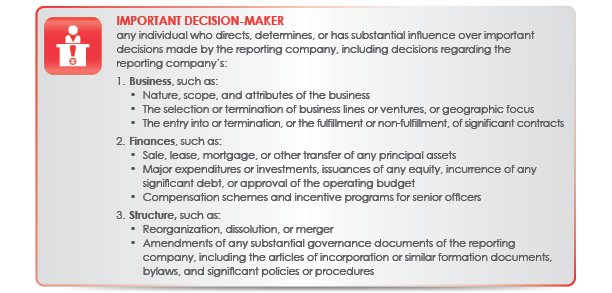
Important decisions include decisions about a reporting company’s business, finances, and structure. An individual that directs, determines, or has substantial influence over these important decisions exercises substantial control over a reporting company. Chapter 2.1, “What is substantial control?” of FinCEN’s Small Entity Compliance Guide provides the following information:
[Issued September 18, 2023]
An ownership interest is generally an arrangement that establishes ownership rights in the reporting company. Examples of ownership interests include shares of equity, stock, voting rights, or any other mechanism used to establish ownership.
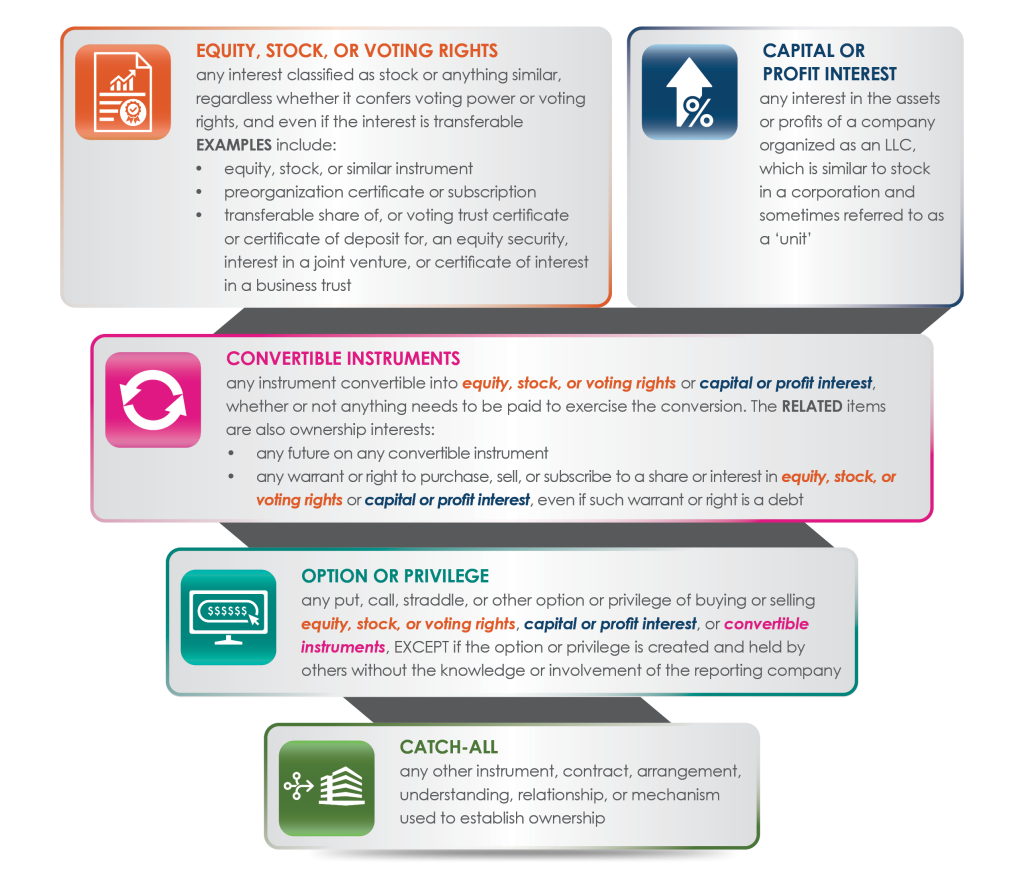
Chapter 2.2, “What is ownership interest?” of FinCEN’s Small Entity Compliance Guide discusses ownership interests and sets out steps to assist in determining the percentage of ownership interests held by an individual.
[Issued September 18, 2023]
There are five instances in which an individual who would otherwise be a beneficial owner of a reporting company qualifies for an exception. In those cases, the reporting company does not have to report that individual as a beneficial owner to FinCEN.
FinCEN’s Small Entity Compliance Guide includes a checklist to help determine whether any exceptions apply to individuals who might otherwise qualify as beneficial owners (see Chapter 2.4. “Who qualifies for an exception from the beneficial owner definition?”).
[Issued September 18, 2023]
Accountants and lawyers generally do not qualify as beneficial owners, but that may depend on the work being performed.
Accountants and lawyers who provide general accounting or legal services are not considered beneficial owners because ordinary, arms-length advisory or other third-party professional services to a reporting company are not considered to be “substantial control” (see Question D.2). In addition, a lawyer or accountant who is designated as an agent of the reporting company may qualify for the “nominee, intermediary, custodian, or agent” exception from the beneficial owner definition.
However, an individual who holds the position of general counsel in a reporting company is a “senior officer” of that company and is therefore a beneficial owner. FinCEN’s Small Entity Compliance Guide includes a checklist to help determine whether an individual qualifies for an exception to the beneficial owner definition (see Chapter 2.4, “Who qualifies for an exception from the beneficial owner definition?”).
[Updated November 16, 2023]
If a beneficial owner owns or controls their ownership interests in a reporting company exclusively through multiple exempt entities, then the names of all of those exempt entities may be reported to FinCEN instead of the individual beneficial owner’s information.
- Note that this special rule does not apply when an individual owns or controls ownership interests in a reporting company through both exempt and non-exempt entities. In that case, the reporting company must report the individual as a beneficial owner (if no exception applies), but the exempt companies do not need to be listed.
FinCEN’s Small Entity Compliance Guide includes more information about this special reporting rule in Chapter 4.2, “What do I report if a special reporting rule applies to my company?”
[Issued September 29, 2023]
The unaffiliated company itself cannot be a beneficial owner of the reporting company because a beneficial owner must be an individual. Any individuals that exercise substantial control over the reporting company through the unaffiliated company must be reported as beneficial owners of the reporting company. However, individuals who do not direct, determine, or have substantial influence over important decisions made by the reporting company, and do not otherwise exercise substantial control, may not be beneficial owners of the reporting company.
Please see Chapter 2.1 of FinCEN’s Small Entity Compliance Guide, “What is substantial control?” for additional information on how to determine whether an individual has substantial control over a reporting company.
[Issued September 29, 2023]
No. A beneficial owner of a company is any individual who, directly or indirectly, exercises substantial control over a reporting company, or who owns or controls at least 25 percent of the ownership interests of a reporting company.
Whether a particular director meets any of these criteria, however, is a question that the reporting company must consider on a director-by-director basis.
FinCEN’s Small Entity Compliance Guide includes additional information on how to determine if an individual qualifies as a beneficial owner in Chapter 2, “Who is a beneficial owner of my company?”. This chapter includes separate sections with more information about substantial control and ownership interest: Chapter 2.1 “What is substantial control?” and Chapter 2.2 “What is ownership interest?”.
[Issued September 29, 2023]
It depends. A reporting company’s “partnership representative,” as defined in 26 U.S.C. 6223, or “tax matters partner,” as the term was previously defined in now-repealed 26 U.S.C. 6231(a)(7), is not automatically a beneficial owner of the reporting company. However, such an individual may qualify as a beneficial owner of the reporting company if the individual exercises substantial control over the reporting company, or owns or controls at least 25 percent of the company’s ownership interests.
Chapter 2 of FinCEN’s Small Entity Compliance Guide (“Who is a beneficial owner of my company?”) has additional information on how to determine if an individual qualifies as a beneficial owner of a reporting company.
Note that a “partnership representative” or “tax matters partner” serving in the role of a designated agent of the reporting company may qualify for the “nominee, intermediary, custodian, or agent” exception from the beneficial owner definition.
FinCEN’s Small Entity Compliance Guide includes additional information on such exemptions in Chapter 2.4, “Who qualifies for an exception from the beneficial owner definition?”
[Issued November 16, 2023]
If ownership of a reporting company is the subject of active litigation and an initial BOI report has not been filed, a person authorized by the company to file its beneficial ownership information should comply with the requirements by reporting:
- all individuals who exercise substantial control over the company, and
- all individuals who own or control, or have a claim to ownership or control of, at least 25 percent ownership interests in the company.
If an initial BOI report has been filed, and if the resolution of the litigation leads to the reporting company having different beneficial owners from those reported (for example, because some individuals’ claims to ownership or control have been rejected), the reporting company must file an updated BOI report within 30 calendar days of resolution of the litigation.
[Issued January 12, 2024]
Ordinarily, such a reporting company reports the individuals who indirectly either (1) exercise substantial control over the reporting company or (2) own or control at least 25 percent of the ownership interests in the reporting company through the corporate entity. It should not report the corporate entity that acts as an intermediate for the individuals.
For an example of how to calculate the percentage of ownership interests an individual owns or controls in a reporting company if the individual’s ownership interests are held through an intermediate entity, please review example 4 in Chapter 2.3, “What steps can I take to identify my company’s beneficial owners?” of FinCEN’s Small Entity Compliance Guide.
Two special rules create exceptions to this general rule in very specific circumstances:
- A reporting company may report the name(s) of an exempt entity or entities in lieu of an individual beneficial owner who owns or controls ownership interests in the reporting company entirely through ownership interests in the exempt entity or entities; or
- If the beneficial owners of the reporting company and the intermediate company are the same individuals, a reporting company may report the FinCEN identifier and full legal name of an intermediate company through which an individual is a beneficial owner of the reporting company.
FinCEN’s Small Entity Compliance Guide includes additional information about these special reporting rules (see Chapter 4.2, “What do I report if a special reporting rule applies to my company?”).
[Issued January 12, 2024]
A homeowners association (HOA) that meets the reporting company definition and does not qualify for any exemptions must report its beneficial owner(s). A beneficial owner is any individual who, directly or indirectly, exercises substantial control over a reporting company, or owns or controls at least 25 percent of the ownership interests of a reporting company.
There may be instances in which no individuals own or control at least 25 percent of the ownership interests of an HOA that is a reporting company. However, FinCEN expects that at least one individual exercises substantial control over each reporting company. Individuals who meet one of the following criteria are considered to exercise substantial control over the HOA:
- the individual is a senior officer;
- the individual has authority to appoint or remove certain officers or a majority of directors of the HOA;
- the individual is an important decision-maker; or
- the individual has any other form of substantial control over the HOA.
[Issued April 18, 2024]
Yes, beneficial owners can own or control a reporting company through trusts. They can do so by either exercising substantial control over a reporting company through a trust arrangement or by owning or controlling the ownership interests of a reporting company that are held in a trust.
[Issued April 18, 2024]
A beneficial owner is any individual who either: (1) exercises substantial control over a reporting company, or (2) owns or controls at least 25 percent of a reporting company’s ownership interests. Exercising substantial control or owning or controlling ownership interests may be direct or indirect, including through any contract, arrangement, understanding, relationship, or otherwise.
Trust arrangements vary. Particular facts and circumstances determine whether specific trustees, beneficiaries, grantors, settlors, and other individuals with roles in a particular trust are beneficial owners of a reporting company whose ownership interests are held through that trust.
For instance, the trustee of a trust may be a beneficial owner of a reporting company either by exercising substantial control over the reporting company, or by owning or controlling at least 25 percent of the ownership interests in that company through a trust or similar arrangement. Certain beneficiaries and grantors or settlors may also own or control ownership interests in a reporting company through a trust. The following conditions indicate that an individual owns or controls ownership interests in a reporting company through a trust:
- a trustee (or any other individual) has the authority to dispose of trust assets;
- a beneficiary is the sole permissible recipient of income and principal from the trust, or has the right to demand a distribution of or withdraw substantially all of the assets from the trust; or
- a grantor or settlor has the right to revoke the trust or otherwise withdraw the assets of the trust.
This may not be an exhaustive list of the conditions under which an individual owns or controls ownership interests in a reporting company through a trust. Because facts and circumstances vary, there may be other arrangements under which individuals associated with a trust may be beneficial owners of any reporting company in which that trust holds interests.
[Issued April 18, 2024]
For purposes of this question, “corporate trustee” means a legal entity rather than an individual exercising the powers of a trustee in a trust arrangement.
If a reporting company’s ownership interests are owned or controlled through a trust arrangement with a corporate trustee, the reporting company should determine whether any of the corporate trustee’s individual beneficial owners indirectly own or control at least 25 percent of the ownership interests of the reporting company through their ownership interests in the corporate trustee.
- For example, if an individual owns 60 percent of the corporate trustee of a trust, and that trust holds 50 percent of a reporting company’s ownership interests, then the individual owns or controls 30 percent (60 percent × 50 percent = 30 percent) of the reporting company’s ownership interests and is therefore a beneficial owner of the reporting company.
- By contrast, if the same trust only holds 30 percent of the reporting company’s ownership interests, the same individual corporate trustee owner only owns or controls 18 percent (60 percent × 30 percent = 18 percent) of the reporting company, and thus is not a beneficial owner of the reporting company by virtue of ownership or control of ownership interests.
The reporting company may, but is not required to, report the name of the corporate trustee in lieu of information about an individual beneficial owner only if all of the following three conditions are met:
- the corporate trustee is an entity that is exempt from the reporting requirements;
- the individual beneficial owner owns or controls at least 25 percent of ownership interests in the reporting company only by virtue of ownership interests in the corporate trustee; and
- the individual beneficial owner does not exercise substantial control over the reporting company.
In addition to considering whether the beneficial owners of a corporate trustee own or control the ownership interests of a reporting company whose ownership interests are held in trust, it may be necessary to consider whether any owners of, or individuals employed or engaged by, the corporate trustee exercise substantial control over a reporting company. The factors for determining substantial control by an individual connected with a corporate trustee are the same as for any beneficial owner.
Please see Chapter 2.1 of FinCEN’s Small Entity Compliance Guide, “What is substantial control?” for additional information on how to determine whether an individual has substantial control over a reporting company.
[Issued April 18, 2024]
The answer depends in part on the nature of the entity owned by the Indian Tribe. This informs the determination on whether the entity is a reporting company that must report beneficial ownership information.
In general, a reporting company must report as beneficial owners all individuals who, directly or indirectly, exercise substantial control over the reporting company (see Question D.2), and any individuals who directly or indirectly own or control at least 25 percent or more of the reporting company’s ownership interests (see Question D.4).
An Indian Tribe is not an individual, and thus should not be reported as an entity’s beneficial owner, even if it exercises substantial control over an entity or owns or controls 25 percent or more of the entity’s ownership interests. However, entities in which Tribes have ownership interests may still have to report one or more individuals as beneficial owners in certain circumstances.
Entity Is a Tribal Governmental Authority. An entity is not a reporting company—and thus does not need to report beneficial ownership information at all—if it is a “governmental authority,” meaning an entity that is (1) established under the laws of the United States, an Indian Tribe, a State, or a political subdivision of a State, or under an interstate compact between two or more States, and that (2) exercises governmental authority on behalf of the United States or any such Indian Tribe, State, or political subdivision. This category includes tribally chartered corporations and state-chartered Tribal entities if those corporations or entities exercise governmental authority on a Tribe’s behalf.
Entity’s Ownership Interests Are Controlled or Wholly Owned by a Tribal Governmental Authority. A subsidiary of a Tribal governmental authority is likewise exempt from BOI reporting requirements if its ownership interests are entirely controlled or wholly owned by the Tribal governmental authority. See Questions L.3 and L.6 for information on this “subsidiary exemption.” See Question C.2 and Section L generally for more information about other exemptions.
Entity Is Partially Owned by a Tribe (and Is Not Exempt). A non-exempt entity partially owned by an Indian Tribe should report as beneficial owners all individuals exercising substantial control over it, including individuals who are exercising substantial control on behalf of an Indian Tribe or its governmental authority. The entity should also report any individuals who directly or indirectly own or control at least 25 percent or more of ownership interests of the reporting company. (However, if any of these individuals owns or controls these ownership interests exclusively through an exempt entity or a combination of exempt entities, then the reporting company may report the name(s) of the exempt entity or entities in lieu of the individual beneficial owner. See Question D.12.)
FinCEN’s Small Entity Compliance Guide includes additional information on how to determine if an individual qualifies as a beneficial owner in Chapter 2, “Who is a beneficial owner of my company?”. This chapter includes separate sections with more information about substantial control and ownership interest: Chapter 2.1 “What is substantial control?” and Chapter 2.2 “What is ownership interest?”
[Updated July 8, 2024]
Possibly. Whether State community property laws affect a beneficial ownership determination will depend upon the specific consequences of applying applicable State law. If, applying community property State law, both spouses own or control at least 25 percent of the ownership interests of a reporting company, then both spouses should be reported to FinCEN as beneficial owners unless an exception applies.
[Issued October 3, 2024]
E. Company Applicant
Only reporting companies created or registered on or after January 1, 2024, will need to report their company applicants.
A company that must report its company applicants will have only up to two individuals who could qualify as company applicants:
- The individual who directly files the document that creates or registers the company; and
- If more than one person is involved in the filing, the individual who is primarily responsible for directing or controlling the filing.
The following flowchart can help identify the company applicant.
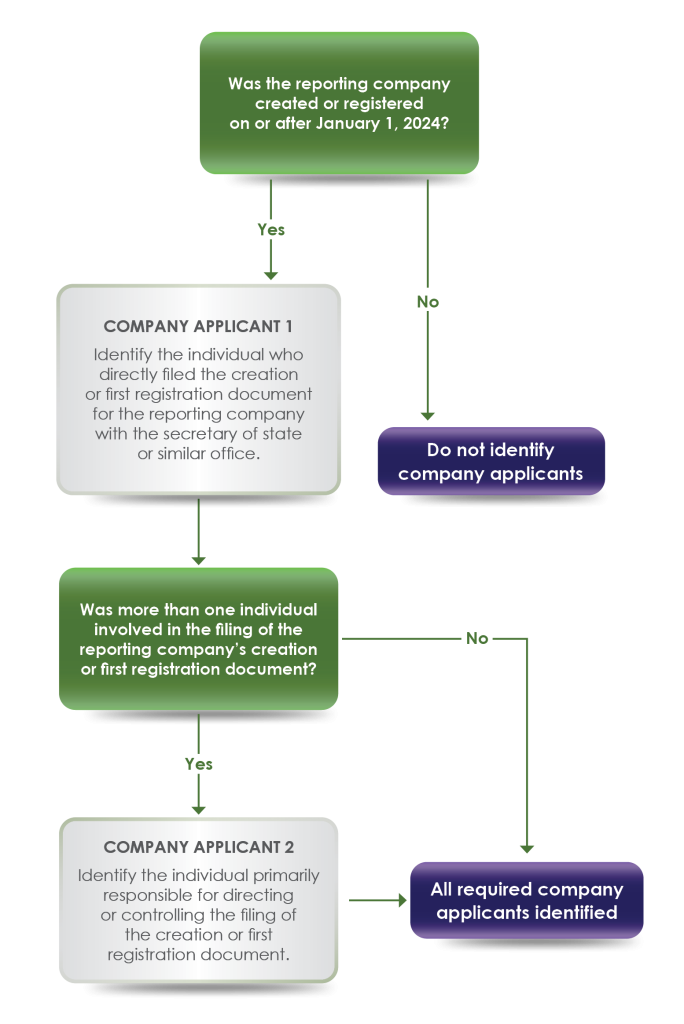
In addition, Chapter 3.2, “Who is a company applicant of my company?” of FinCEN’s Small Entity Compliance Guide includes additional information to help identify company applicants.
[Issued September 18, 2023]
Not all reporting companies have to report their company applicants to FinCEN.
A reporting company must report its company applicants only if it is either a:
- Domestic reporting company created in the United States on or after January 1, 2024; or
- Foreign reporting company first registered to do business in the United States on or after January 1, 2024.
A reporting company does not have to report its company applicants if it is either a:
- Domestic reporting company created in the United States before January 1, 2024; or
- Foreign reporting company first registered to do business in the United States before January 1, 2024.
Below is summary of the company applicant reporting requirement. Chapter 3.1, “Is my company required to report its company applicants?” of FinCEN’s Small Entity Compliance Guide includes additional information.
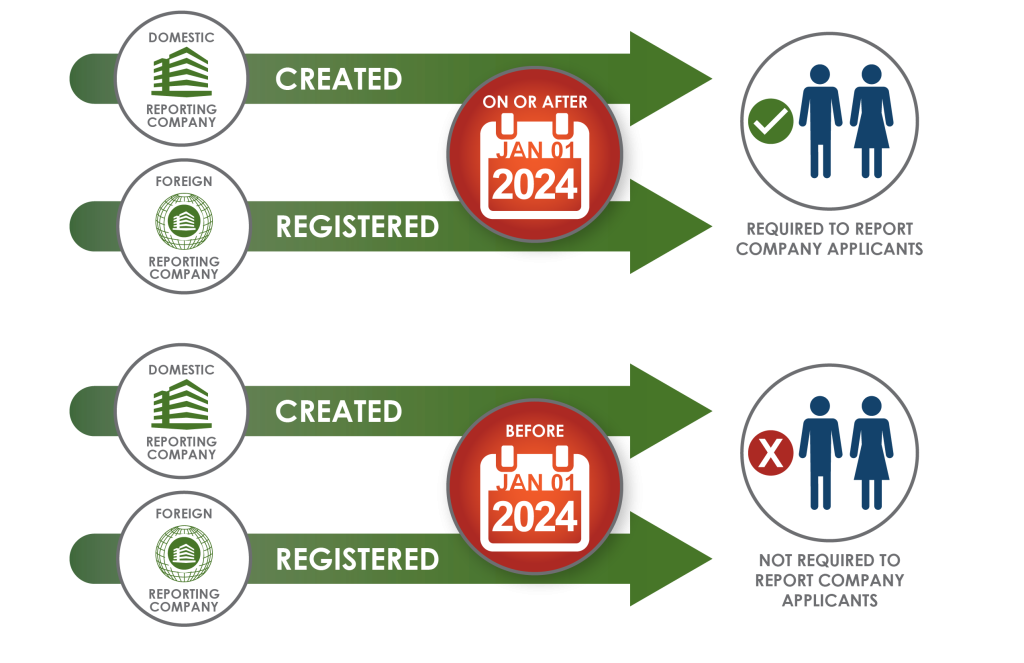
[Issued September 18, 2023]
An accountant or lawyer could be a company applicant, depending on their role in filing the document that creates or registers a reporting company. In many cases, company applicants may work for a business formation service or law firm.
An accountant or lawyer may be a company applicant if they directly filed the document that created or registered the reporting company. If more than one person is involved in the filing of the creation or registration document, an accountant or lawyer may be a company applicant if they are primarily responsible for directing or controlling the filing.
For example, an attorney at a law firm that offers business formation services may be primarily responsible for overseeing preparation and filing of a reporting company’s incorporation documents. A paralegal at the law firm may directly file the incorporation documents at the attorney’s request. Under those circumstances, the attorney and the paralegal are both company applicants for the reporting company.
[Issued September 18, 2023]
No. A company applicant may not be removed from a BOI report even if the company applicant no longer has a relationship with the reporting company. A reporting company created on or after January 1, 2024, is required to report company applicant information in its initial BOI report, but is not required to file an updated BOI report if information about a company applicant changes.
[Issued November 16, 2023]
At most, two individuals need to be reported as company applicants:
- the person who directly files the document with a secretary of state or similar office, and
- if more than one person is involved in the filing of the document, the person who is primarily responsible for directing or controlling the filing.
For the purposes of determining who is a company applicant, it is not relevant who signs the creation or registration document, for example, as an incorporator. To determine who is primarily responsible for directing or controlling the filing of the document, consider who is responsible for making the decisions about the filing of the document, such as how the filing is managed, what content the document includes, and when and where the filing occurs. The following three scenarios provide examples.
Scenario 1: Consider an attorney who completes a company creation document using information provided by a client, and then sends the document to a corporate service provider for filing with a secretary of state. In this example:
- The attorney is the company applicant who is primarily responsible for directing or controlling the filing because they prepared the creation document and directed the corporate service provider to file it.
- The individual at the corporate service provider is the company applicant who directly filed the document with the secretary of state.
Scenario 2: If the attorney instructs a paralegal to complete the preparation of the creation document, rather than doing so themself, before directing the corporate service provider to file the document, the outcome remains the same: the attorney and the individual at the corporate service provider who files the document are company applicants. The paralegal is not a company applicant because the attorney played a greater role than the paralegal in making substantive decisions about the filing of the document.
Scenario 3: If the client who initiated the company creation directly asks the corporate service provider to file the document to create the company, then the client is primarily responsible for directing or controlling the filing, and the client should be reported as a company applicant, along with the individual at the corporate service provider who files the document.
[Issued January 12, 2024]
No. A third-party courier or delivery service employee who only delivers documents to a secretary of state or similar office is not a company applicant provided they meet one condition: the third-party courier, the delivery service employee, and any delivery service that employs them does not play any other role in the creation or registration of the reporting company.
When a third-party courier or delivery service employee is used solely for delivery, the individual (e.g., at a business formation service or law firm) who requested the third-party courier or delivery service to deliver the document will typically be a company applicant.
Under FinCEN’s regulations, an individual who “directly files the document” that creates or registers the reporting company is a company applicant. Third-party couriers or delivery service employees who deliver such documents facilitate the documents’ filing, but FinCEN does not consider them to be the filers of the documents given their only connection to the creation or registration of the reporting company is couriering the documents.
Rather, when a third-party courier or delivery service is used by a firm, the company applicant who “directly files” the creation or registration document is the individual at the firm who requests that the third-party courier or delivery service deliver the documents.
- For example, an attorney at a law firm may be involved in the preparation of incorporation documents. The attorney directs a paralegal to file the documents. The paralegal may then request a third-party delivery service to deliver the incorporation documents to the secretary of state’s office. The paralegal is the company applicant who directly files the documents, even though the third-party delivery service delivered the documents on the paralegal’s behalf. The attorney at the law firm who was involved in the preparation of the incorporation documents and who directed the paralegal to file the documents will also be a company applicant because the attorney was primarily responsible for directing or controlling the filing of the documents.
In contrast, if a courier is employed by a business formation service, law firm, or other entity that plays a role in the creation or registration of the reporting company, such as drafting the relevant documents or compiling information to be submitted as part of the documents delivered, the conclusion is different. FinCEN considers such a courier to have directly filed the documents—and thus to be a company applicant—given the courier’s greater connection (via the courier’s employer) to the creation or registration of the company.
- For example, a mailroom employee at a law firm may physically deliver the document that creates a reporting company at the direction of an attorney at the law firm who is primarily responsible for decisions related to the filing. Both individuals are company applicants.
[Issued January 12, 2024]
If a business formation service only provides software, online tools, or generally applicable written guidance that are used to file a creation or registration document for a reporting company, and employees of the business service are not directly involved in the filing of the document, the employees of such services are not company applicants. For example, an individual may prepare and self-file documents to create the individual’s own reporting company through an automated incorporation service. In this case, this reporting company reports only that individual as a company applicant.
[Issued January 12, 2024]
F. Reporting Requirements
Yes. The information that needs to be reported, however, depends on when the company was created or registered.
- If a reporting company is created or registered on or after January 1, 2024, the reporting company will need to report information about itself, its beneficial owners, and its company applicants.
- If a reporting company was created or registered before January 1, 2024, the reporting company only needs to provide information about itself and its beneficial owners. The reporting company does not need to provide information about its company applicants.
[Issued March 24, 2023]
A reporting company will have to report:
- Its legal name;
- Any trade names, “doing business as” (d/b/a), or “trading as” (t/a) names;
- The current street address of its principal place of business if that address is in the United States (for example, a U.S. reporting company’s headquarters), or, for reporting companies whose principal place of business is outside the United States, the current address from which the company conducts business in the United States (for example, a foreign reporting company’s U.S. headquarters);
- Its jurisdiction of formation or registration; and
- Its Taxpayer Identification Number (or, if a foreign reporting company has not been issued a TIN, a tax identification number issued by a foreign jurisdiction and the name of the jurisdiction).
A reporting company will also have to indicate whether it is filing an initial report, or a correction or an update of a prior report.
FinCEN’s Small Entity Compliance Guide includes a checklist to help identify the information required to be reported (see Chapter 4.1, “What information should I collect about my company, its beneficial owners, and its company applicants?”).
[Issued September 18, 2023]
For each individual who is a beneficial owner, a reporting company will have to provide:
- The individual’s name;
- Date of birth;
- Residential address; and
- An identifying number from an acceptable identification document such as a passport or U.S. driver’s license, and the name of the issuing state or jurisdiction of identification document (for examples of acceptable identification, see Question F.5).
The reporting company will also have to report an image of the identification document used to obtain the identifying number in item 4.
FinCEN’s Small Entity Compliance Guide includes a checklist to help identify the information required to be reported (see Chapter 4.1, “What information should I collect about my company, its beneficial owners, and its company applicants?”).
[Issued September 18, 2023]
For each individual who is a company applicant, a reporting company will have to provide:
- The individual’s name;
- Date of birth;
- Address; and
- An identifying number from an acceptable identification document such as a passport or U.S. driver’s license, and the name of the issuing state or jurisdiction of identification document (for examples of acceptable identification, see Question F.5).
The reporting company will also have to report an image of the identification document used to obtain the identifying number in item 4.
If the company applicant works in corporate formation—for example, as an attorney or corporate formation agent—then the reporting company must report the company applicant’s business address. Otherwise, the reporting company must report the company applicant’s residential address.
FinCEN’s Small Entity Compliance Guide includes a checklist to help identify the information required to be reported (see Chapter 4.1, “What information should I collect about my company, its beneficial owners, and its company applicants?”).
[Issued September 18, 2023]
The Corporate Transparency Act (CTA) requires a unique identification number found in one of the following acceptable forms of identification for individuals:
- A non-expired U.S. driver’s license (including any driver’s license issued by a commonwealth, territory, or possession of the United States);
- A non-expired identification document issued by a U.S. State or local government, or Indian Tribe;
- A non-expired passport issued by the U.S. government; or
- A non-expired passport issued by a foreign government (permitted only when an individual does not have one of the other three forms of identification listed above).
[Updated June 10, 2024]
What is an example of a “non-expired identification document issued by a U.S. State or local government, or Indian Tribe”?
A “non-expired identification document issued by a U.S. State or local government, or Indian Tribe” is a document issued by such authorities specifically for use as proof of the holder’s identity. Such documents typically, but not always, include a photograph of the holder (see Question F.10). For example, a non-expired identification card issued by a State’s Department of Corrections for the purpose of identifying a currently or previously incarcerated individual is an acceptable identification document. This is distinct from personal documents that serve functions other than use as proof of a holder’s identity, such as recording a birth (a “birth certificate”) or granting the holder access to particular government services (e.g., a “library card”).
[Issued October 3, 2024]
Is a U.S. passport card an acceptable form of identification?
Yes. With respect to Item 3 of the above list, a U.S. passport card is considered a type of passport issued by the U.S. government, and a non-expired U.S. passport card is therefore an acceptable form of identification.
[Issued October 3, 2024]
No. There is no annual reporting requirement. Reporting companies must file an initial BOI report and updated or corrected BOI reports as needed.
FinCEN’s Small Entity Compliance Guide includes more information about when to file initial BOI reports in Chapter 5.1, “When should my company file its initial BOI report?” and when to file updated and corrected BOI reports in Chapter 6, “What if there are changes to or inaccuracies in reported information?”
[Issued November 16, 2023]
No, though if a special reporting rule applies, the reporting company may report a parent company’s name instead of beneficial ownership information. A reporting company usually must report information about itself, its beneficial owners, and, for reporting companies created or registered on or after January 1, 2024, its company applicants. However, under a special reporting rule, a reporting company may report a parent company’s name in lieu of information about its beneficial owners if its beneficial owners only hold their ownership interest in the reporting company through the parent company and the parent company is an exempt entity.
Chapter 4 of FinCEN’s Small Entity Compliance Guide (“What specific information does my company need to report?”) provides additional information on what must be reported to FinCEN. Chapter 4.2 (“What do I report if a special reporting rule applies to my company?”) specifically provides details on what information must be reported pursuant to special reporting rules.
[Issued December 12, 2023]
No. The reporting company address must be a U.S. street address and cannot be a P.O. box.
FinCEN’s Small Entity Compliance Guide includes additional information on what must be reported in Chapter 4, “What specific information does my company need to report?”
[Issued December 12, 2023]
No. Reporting companies must report beneficial ownership information directly to FinCEN. Congress enacted a law, the Corporate Transparency Act, that requires the reporting of beneficial ownership information directly to FinCEN. State or local governments, financial institutions, and other federal agencies, such as the IRS, may separately require entities to report certain beneficial ownership information. However, by law, those requirements are not a substitute for reporting beneficial ownership information to FinCEN.
[Issued December 12, 2023]
Yes. If a beneficial owner or company applicant’s identification document does not include a photograph for religious reasons, the reporting company may nonetheless submit an image of that identification document when submitting its report, as long as the identification document is one of the types of identification accepted by FinCEN, such as a non-expired State-issued identification document. Please see Question F.5 for a list of acceptable identification documents.
[Issued January 12, 2024]
The residential address that is current at the time of filing should be reported to FinCEN. An updated report should be submitted within 30 calendar days if the address, or any other information previously reported, changes.
FinCEN’s Small Entity Compliance Guide includes additional information on what information must be reported in Chapter 4, “What specific information does my company need to report?” and what to do when previously reported information needs to be updated in Chapter 6.1 “What should I do if previously reported information changes?”
[Issued January 12, 2024]
If a reporting company does not have a principal place of business in the United States, then the company must report to FinCEN as its address the primary location in the United States where it conducts business.
If a reporting company has no principal place of business in the United States and conducts business at more than one location within the United States, then the reporting company may report as its primary location the address of any of those locations where the reporting company receives important correspondence.
If a reporting company has no principal place of business in the United States and does not generally conduct business functions at any location in the United States, then its primary location is the address in the United States of the person that the reporting company, under State or other applicable law, has designated to accept service of legal process on its behalf. In some jurisdictions, this person is referred to as the reporting company’s registered agent, or the address is referred to as the registered office. Such a reporting company should report this address to FinCEN as its address. FinCEN will understand the use of such an address to mean that: (i) the registered agent or other person at the address designated to accept service of legal process has consented to the use of its address in this capacity, and (ii) the reporting company does not generally conduct business functions at any other location in the United States.
[Updated October 3, 2024]
An entity that is disregarded for U.S. tax purposes—a “disregarded entity”—is not treated as an entity separate from its owner for U.S. tax purposes. Instead of a disregarded entity being taxed separately, the entity’s owner reports the entity’s income and deductions as part of the owner’s federal tax return.
A disregarded entity must report beneficial ownership information (BOI) to FinCEN if it is a reporting company (see Question C.1). Such a reporting company must provide one of the following types of taxpayer identification numbers (TINs) on its BOI report if it has been issued a TIN: an Employer Identification Number (EIN); a Social Security Number (SSN); or an Individual Taxpayer Identification Number (ITIN). If a foreign reporting company has not been issued a TIN, it must provide a tax identification number issued by a foreign jurisdiction and the name of that jurisdiction.
Consistent with rules of the Internal Revenue Service (IRS) regarding the use of TINs, different types of tax identification numbers may be reported for disregarded entities under different circumstances:
- If the disregarded entity has its own EIN, it may report that EIN as its TIN. If the disregarded entity does not have an EIN, it is not required to obtain one to meet its BOI reporting requirements so long as it can instead provide another type of TIN or, if a foreign reporting company not issued a TIN, a tax identification number issued by a foreign jurisdiction and the name of that jurisdiction.
- If the disregarded entity is a single-member limited liability company (LLC) or otherwise has only one owner that is an individual with an SSN or ITIN, the disregarded entity may report that individual’s SSN or ITIN as its TIN.
- If the disregarded entity is owned by a U.S. entity that has an EIN, the disregarded entity may report that other entity’s EIN as its TIN.
- If the disregarded entity is owned by another disregarded entity or a chain of disregarded entities, the disregarded entity may report the TIN of the first owner up the chain of disregarded entities that has a TIN as its TIN.
As explained above, a disregarded entity that is a reporting company must report one of these tax identification numbers when reporting beneficial ownership information to FinCEN
[Issued July 24, 2024]
FinCEN is mindful of the critical privacy interests protected by ACPs. Reporting companies that are required to report a beneficial owner or company applicant registered with a State’s ACP should report to FinCEN the ACP address that the State provided to the individual. As a best practice, individuals registered with a State ACP may consider retaining documentation to demonstrate that they participate in an ACP.
[Issued October 3, 2024]
No. If the name on the identification document of a beneficial owner or company applicant does not match their current full legal name due to a recent legal name change, the individual’s current full legal name should be reported to FinCEN. The individual may report an acceptable identifying document that does not include the updated full legal name. This also applies when an individual is requesting a FinCEN identifier.
If the requester obtains a new driver’s license or other acceptable identifying document that includes a changed name, address, or identifying number, the requester should update the information already provided to FinCEN, either by filing an updated beneficial ownership information report or updating the previously filed FinCEN identifier information, including by submitting an image of the new identification document.
See Question F.5 “What are acceptable forms of identification that will meet the reporting requirement?” for a list of the acceptable forms of identification
[Issued October 3, 2024]
G. Initial Report
If your company existed before January 1, 2024, it must file its initial beneficial ownership information report by January 1, 2025.
If your company was created or registered on or after January 1, 2024, and before January 1, 2025, then it must file its initial beneficial ownership information report within 90 calendar days after receiving actual or public notice that its creation or registration is effective. Specifically, this 90-calendar day deadline runs from the time the company receives actual notice that its creation or registration is effective, or after a secretary of state or similar office first provides public notice of its creation or registration, whichever is earlier.
If your company was created or registered on or after January 1, 2025, it must file its initial beneficial ownership information report within 30 calendar days after receiving actual or public notice that its creation or registration is effective. The following sets out the initial report timelines. .
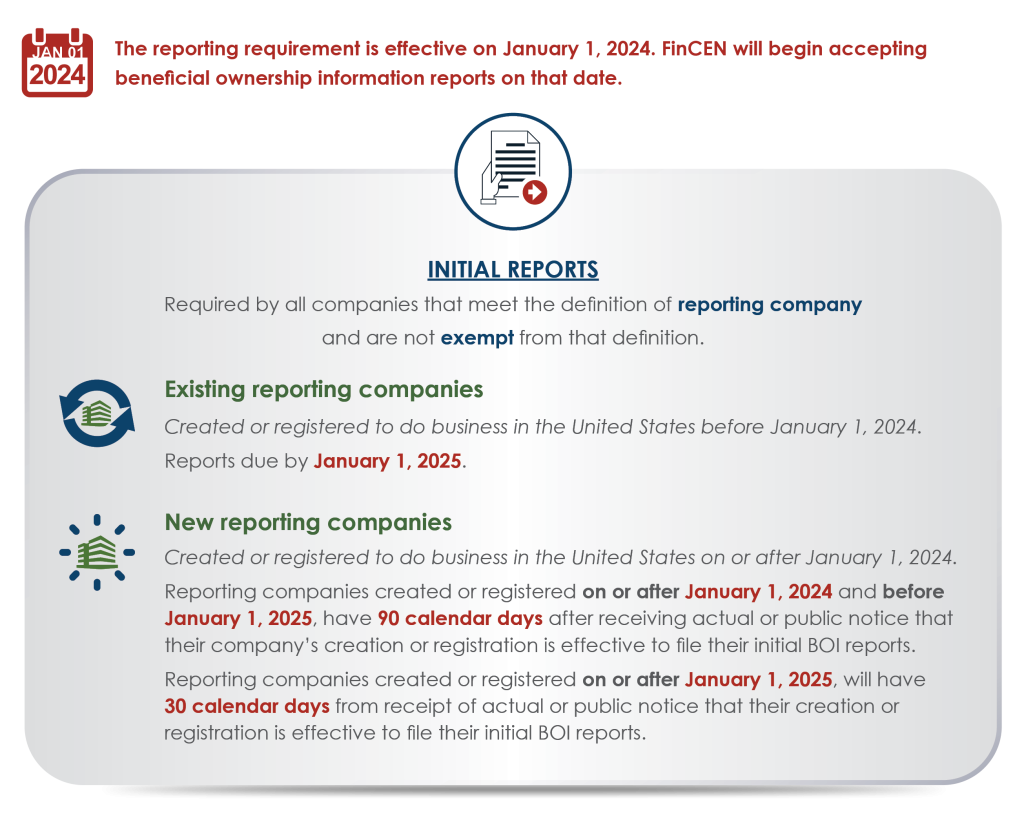
Chapter 5.1 “When should my company file its initial BOI report?” of FinCEN’s Small Entity Compliance Guide has additional information about the reporting timelines.
[Updated December 1, 2023]
No. Any company that meets the definition of a reporting company and is not exempt is required to file its own BOI report.
[Issued September 29, 2023]
A reporting company must provide one of the following types of taxpayer identification numbers (TINs) on its BOI report if it has been issued a TIN: an Employer Identification Number (EIN); a Social Security Number (SSN); or an Individual Taxpayer Identification Number (ITIN). If a foreign reporting company has not been issued a TIN, it must provide a tax identification number issued by a foreign jurisdiction and the name of that jurisdiction.
The Internal Revenue Service (IRS) offers a free online application for an EIN, which is provided immediately upon submission of the application. For more information, see “Taxpayer Identification Numbers (TIN)” at IRS.gov (https://www.irs.gov/individuals/international-taxpayers/taxpayer-identification-numbers-tin).
For more information on Employer Identification Numbers specifically, and to access the EIN online application, see “Apply for an Employer Identification Number (EIN) Online” at IRS.gov (https://www.irs.gov/businesses/small-businesses-self-employed/apply-for-an-employer-identification-number-ein-online).
Most reporting companies should be able to use the EIN online application to apply for their EIN. However, there may be situations where a reporting company needs to file a Form SS-4, Application for Employer Identification Number (https://www.irs.gov/pub/irs-pdf/fss4.pdf), in order to obtain an EIN. In particular, if the responsible party for the applicant is a foreign person that does not have an SSN or ITIN, they will not be able to use the online application portal. For information about completing and submitting the Form SS-4 by mail for fax, see the Instructions to Form SS-4 (https://www.irs.gov/instructions/iss4).
For Forms SS-4 submitted by fax, applicants should generally receive their EIN in four business days. For Forms SS-4 submitted by mail, applicants should receive their EIN in four to five weeks. However, in some circumstances, it may take six to eight weeks to receive an EIN. Thus, in some limited circumstances, a reporting company with no other tax identification number may not be able to obtain its EIN by its BOI report filing deadline.
A reporting company must report its tax identification number when reporting beneficial ownership information to FinCEN and, indeed, will be unable to submit its BOI report without including a tax identification number. In such circumstances, in addition to making all reasonable efforts to file its BOI report in a timely manner (including requesting all necessary information as early as practicable), the reporting company should file its report as soon as it receives its EIN. As a best practice, the reporting company may consider retaining documentation associated with its efforts to comply with the BOI reporting requirements in a timely manner.
[Updated July 24, 2024]
Except as noted below, an initial BOI report should only include the beneficial owners as of the time of the filing. Reporting companies should notify FinCEN of changes to beneficial owners and related BOI through updated reports.
If a reporting company created or registered in 2024 or later ceases to exist before the expiration of the 30- or 90-day period reporting companies have to report their beneficial ownership information to FinCEN, but no one submits the reporting company’s initial beneficial ownership information report to FinCEN until after the reporting company ceases to exist, then that beneficial ownership information report should reflect the beneficial ownership information accurate as of the moment prior to the reporting company ceasing to exist.
FinCEN’s Small Entity Compliance Guide includes more information about when to file updated or corrected BOI reports in Chapter 6, “What if there are changes to or inaccuracies in reported information?”
[Updated September 10, 2024]
The date of creation or registration for a reporting company is the earlier of the date on which: (1) the reporting company receives actual notice that its creation (or registration) has become effective; or (2) a secretary of state or similar office first provides public notice, such as through a publicly accessible registry, that the domestic reporting company has been created or the foreign reporting company has been registered.
FinCEN recognizes that there are varying state filing practices. In certain states, automated systems provide notice of creation or registration to newly created or registered companies. In other states, no actual notice of creation or registration is provided, and newly created companies receive notice through the public posting of state records. FinCEN believes that individuals who create or register reporting companies will likely stay apprised of creation or registration notices or publications, given those individuals’ interest in establishing an operating business or engaging in the activity for which the reporting company is created.
[Issued December 12, 2023]
Normally, a company that loses its exempt status must file a BOI report with FinCEN within 30 calendar days after the date that it no longer meets the criteria for any exemption. A reporting company created or registered to do business before January 1, 2024, however, has until January 1, 2025, to file its initial BOI report.
FinCEN has determined that previously exempt entities that existed before 2024 and lose their exempt status in 2024 will receive the benefit of whichever of these two timeframes is longer: (1) the remaining days left in the one-year filing period for existing companies; or (2) the 30-calendar-day period for companies that lose their exempt status.
Thus, for example, if an existing reporting company ceases to be exempt on February 1, 2024, the company will have until January 1, 2025, to file its initial BOI report. If the company ceases to be exempt on December 15, 2024, the company will have until January 14, 2025, to file its initial BOI report.
[Issued April 18, 2024]
H. Updated Report
If there is any change to the required information about your company or its beneficial owners in a beneficial ownership information report that your company filed, your company must file an updated report no later than 30 days after the date of the change.
A reporting company is not required to file an updated report for any changes to previously reported information about a company applicant.
The following infographic sets out updated reports timelines.
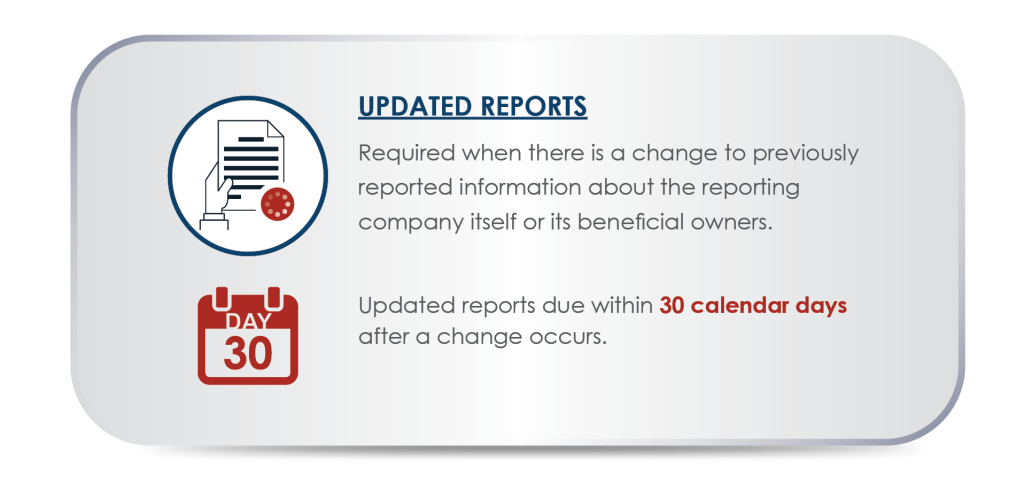
Chapter 6.1, “What should I do if previously reported information changes?” of FinCEN’s Small Entity Compliance Guide provides additional information.
[Issued September 18, 2023]
The following are some examples of the changes that would require an updated beneficial ownership information report:
- Any change to the information reported for the reporting company, such as registering a new business name.
- A change in beneficial owners, such as a new CEO, or a sale that changes who meets the ownership interest threshold of 25 percent (see Question D.4 for more information about ownership interests).
- Any change to a beneficial owner’s name, address, or unique identifying number previously provided to FinCEN. If a beneficial owner obtained a new driver’s license or other identifying document that includes a changed name, address, or identifying number, the reporting company also would have to file an updated beneficial ownership information report with FinCEN, including an image of the new identifying document.
FinCEN’s Small Entity Compliance Guide provides additional guidance on triggers requiring an updated beneficial ownership information report (see Chapter 6.1 “What should I do if previously reported information changes?”).
[Issued September 18, 2023]
No. A change to the type of ownership interest a beneficial owner has in a reporting company—for example, a conversion of preferred shares to common stock—does not require the reporting company to file an updated BOI report because FinCEN does not require companies to report the type of interest. Updated BOI reports are required when information reported to FinCEN about the reporting company or its beneficial owners changes.
FinCEN’s Small Entity Compliance Guide includes additional information on when and how reporting companies must update information in Chapter 6, “What if there are changes to or inaccuracies in reported information?”
[Issued December 12, 2023]
Updated BOI reports will require all fields to be submitted, including the updated pieces of information. For example, if a reporting company changes its legal name, the reporting company will need to file an updated BOI report to include the new legal name and the previously reported, unchanged information about the company, its beneficial owners, and, if required, its company applicants.
A reporting company that filed its prior BOI report using the fillable PDF version may update its saved copy and resubmit to FinCEN. If a reporting company used FinCEN’s web-based application to submit the previous BOI report, it will need to submit a new report in its entirety by either accessing FinCEN’s web-based application to complete and file the BOI report, or by using the PDF option to complete the BOI report and upload to the BOI e-Filing application.
[Issued December 12, 2023]
An updated BOI report can be submitted to FinCEN at any time. However, the reporting company is responsible for ensuring that updates are filed within 30 days of a change occurring. If a reporting company has engaged a third-party service provider to file BOI reports and updates on its behalf, then it should communicate any changes to its beneficial ownership information to the third-party service provider with enough time to meet the 30-day deadline.
[Issued December 12, 2023]
A reporting company should file an updated BOI report with FinCEN with the company’s current beneficial ownership information when it determines it no longer qualifies for an exemption.
[Issued December 12, 2023]
I. Corrected Report
If a beneficial ownership information report is inaccurate, your company must correct it no later than 30 days after the date your company became aware of the inaccuracy or had reason to know of it. This includes any inaccuracy in the required information provided about your company, its beneficial owners, or its company applicants. The following infographic sets out the corrected report timelines.
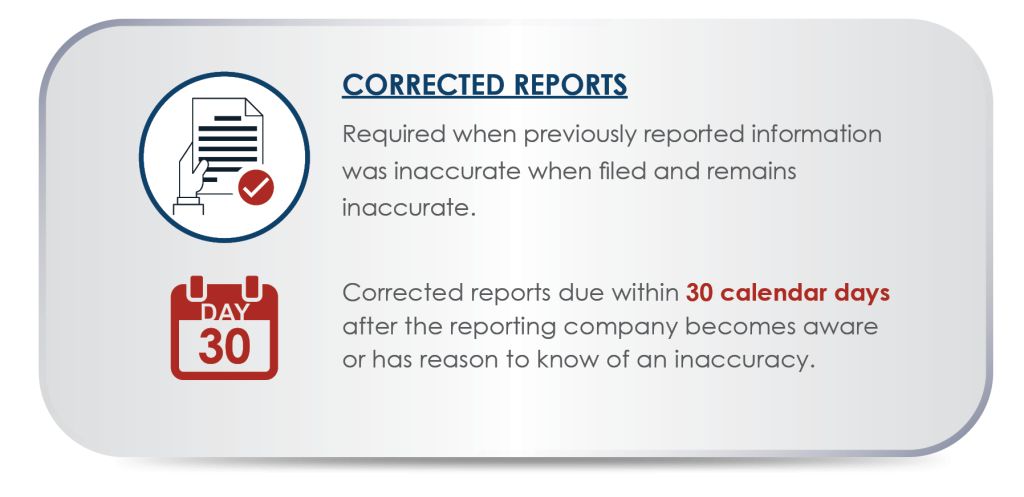
Chapter 6.2, “What should I do if I learn of an inaccuracy in a report?” of FinCEN’s Small Entity Compliance Guide includes additional information about correcting inaccurate beneficial ownership information reports filed with FinCEN.
[Updated September 29, 2023]
J. Newly Exempt Entity Report
If a reporting company filed a beneficial ownership information report but then becomes exempt from filing the report, the company should file an updated report indicating that it is no longer a reporting company. An updated BOI report for a newly exempt entity will only require that: (1) the entity identify itself; and (2) check a box noting its newly exempt status. Chapter 6.3, “What should my company do if it becomes exempt after already filing a report?” of FinCEN’s Small Entity Compliance Guide includes more information.
[Issued September 18, 2023]
K. Compliance/Enforcement
FinCEN is working hard to ensure that reporting companies are aware of their obligations to report, update, and correct beneficial ownership information. FinCEN understands this is a new requirement. If you correct a mistake or omission within 90 days of the deadline for the original report, you may avoid being penalized. However, you could face civil and criminal penalties if you disregard your beneficial ownership information reporting obligations.
FinCEN’s Small Entity Compliance Guide provides more information about enforcement of the requirement (see Chapter 1.3, “What happens if my company does not report BOI in the required timeframe?”).
[Issued September 18, 2023]
As specified in the Corporate Transparency Act, a person who willfully violates the BOI reporting requirements may be subject to civil penalties of up to $500 for each day that the violation continues. However, this civil penalty amount is adjusted annually for inflation. As of the time of publication of this FAQ, this amount is $591.
A person who willfully violates the BOI reporting requirements may also be subject to criminal penalties of up to two years imprisonment and a fine of up to $10,000. Potential violations include willfully failing to file a beneficial ownership information report, willfully filing false beneficial ownership information, or willfully failing to correct or update previously reported beneficial ownership information.
[Updated April 18, 2024]
Both individuals and corporate entities can be held liable for willful violations. This can include not only an individual who actually files (or attempts to file) false information with FinCEN, but also anyone who willfully provides the filer with false information to report. Both individuals and corporate entities may also be liable for willfully failing to report complete or updated beneficial ownership information; in such circumstances, individuals can be held liable if they either cause the failure or are a senior officer at the company at the time of the failure.
- i. Can an individual who files a report on behalf of a reporting company be held liable?
- Yes. An individual who willfully files a false or fraudulent beneficial ownership information report on a company’s behalf may be subject to the same civil and criminal penalties as the reporting company and its senior officers.
- ii. Can a beneficial owner or company applicant be held liable for refusing to provide required information to a reporting company?
- Yes. As described above, an enforcement action can be brought against an individual who willfully causes a reporting company’s failure to submit complete or updated beneficial ownership information to FinCEN. This would include a beneficial owner or company applicant who willfully fails to provide required information to a reporting company.
[Issued December 12, 2023]
Yes. It is the responsibility of the reporting company to identify its beneficial owners and company applicants, and to report those individuals to FinCEN. At the time the filing is made, each reporting company is required to certify that its report or application is true, correct, and complete. Accordingly, FinCEN expects that reporting companies will take care to verify the information they receive from their beneficial owners and company applicants before reporting it to FinCEN.
[Issued December 12, 2023]
While FinCEN recognizes that much of the information required to be reported about beneficial owners and company applicants will be provided to reporting companies by those individuals, reporting companies are responsible for ensuring that they submit complete and accurate beneficial ownership information to FinCEN. Starting January 1, 2024, reporting companies will have a legal requirement to report beneficial ownership information to FinCEN.
Existing reporting companies should engage with their beneficial owners to advise them of this requirement, obtain required information, and revise or consider putting in place mechanisms to ensure that beneficial owners will keep reporting companies apprised of changes in reported information, if necessary. Beneficial owners and company applicants should also be aware that they may face penalties if they willfully cause a reporting company to fail to report complete or updated beneficial ownership information.
Persons considering creating or registering legal entities that will be reporting companies should take steps to ensure that they have access to the beneficial ownership information required to be reported to FinCEN, and that they have mechanisms in place to ensure that the reporting company is kept apprised of changes in that information.
[Issued December 12, 2023]
L. Reporting Company Exemptions
An entity qualifies for the tax-exempt entity exemption if any of the following four criteria apply:
| (1) The entity is an organization that is described in section 501(c) of the Internal Revenue Code of 1986 (Code) (determined without regard to section 508(a) of the Code) and exempt from tax under section 501(a) of the Code. |
| (2) The entity is an organization that is described in section 501(c) of the Code, and was exempt from tax under section 501(a) of the Code, but lost its tax-exempt status less than 180 days ago. |
| (3) The entity is a political organization, as defined in section 527(e)(1) of the Code, that is exempt from tax under section 527(a) of the Code. |
| (4) The entity is a trust described in paragraph (1) or (2) of section 4947(a) of the Code. |
FinCEN’s Small Entity Compliance Guide includes checklists for this exemption (see exemption #19) and for the additional exemptions to the reporting requirements (see Chapter 1.2, “Is my company exempt from the reporting requirements?”).
[Issued September 18, 2023]
An entity qualifies for the inactive entity exemption if all six of the following criteria are met
- The entity was in existence on or before January 1, 2020.
- The entity is not engaged in active business.
- The entity is not owned by a foreign person, whether directly or indirectly, wholly or partially. “Foreign person” means a person who is not a United States person. A “United States person” is defined in section 7701(a)(30) of the Internal Revenue Code of 1986 as: a citizen or resident of the United States; domestic partnership; a domestic corporation; and certain estates and trusts.
- The entity has not experienced any change in ownership in the preceding twelve-month period.
- The entity has not sent or received any funds in an amount greater than $1,000, either directly or through any financial account in which the entity or any affiliate of the entity had an interest, in the preceding twelve-month period.
- The entity does not otherwise hold any kind or type of assets, whether in the United States or abroad, including any ownership interest in any corporation, limited liability company, or other similar entity.
FinCEN’s Small Entity Compliance Guide includes checklists for this exemption (see exemption #23) and for the additional exemptions to the reporting requirements (see Chapter 1.2, “Is my company exempt from the reporting requirements?”).
[Issued September 18, 2023]
Subsidiaries of certain types of entities that are exempt from the beneficial ownership information reporting requirements may also be exempt from the reporting requirement.
An entity qualifies for the subsidiary exemption if the following applies:
The entity’s ownership interests are controlled or wholly owned, directly or indirectly, by any of these types of exempt entities:
The entity’s ownership interests are controlled or wholly owned, directly or indirectly, by any of these types of exempt entities:
- Securities reporting issuer;
- Governmental authority;
- Bank;
- Credit union;
- Depository institution holding company;
- Broker or dealer in securities;
- Securities exchange or clearing agency;
- Other Exchange Act registered entity;
- Investment company or investment adviser;
- Venture capital fund adviser;
- Insurance company;
- State-licensed insurance producer;
- Commodity Exchange Act registered entity;
- Accounting firm;
- Public utility;
- Financial market utility;
- Tax-exempt entity; or
- Large operating company.
FinCEN’s Small Entity Compliance Guide includes definitions of the exempt entities listed above and a checklist for this exemption (see exemption #22). FinCEN’s Guide also includes checklists for the additional exemptions to the reporting requirements (see Chapter 1.2, “Is my company exempt from the reporting requirements?”).
[Issued September 18, 2023]
If a reporting company’s ownership interests are controlled or wholly owned, directly or indirectly, by more than one exempt entity, do the entities need to be affiliated to qualify for the subsidiary exemption?
No. If a reporting company’s ownership interests are controlled or wholly owned by more than one exempt entity, the reporting company may still qualify for the subsidiary exemption if the entities are unaffiliated; however, every controlling or owning entity must itself be an exempt entity in order for the reporting company to qualify for the subsidiary exemption.
[Issued October 3, 2024]
No. The large operating company exemption requires that the entity itself employ more than 20 full-time employees in the United States and does not permit consolidation of this employee count across multiple entities.
FinCEN’s Small Entity Compliance Guide includes a checklist for this exemption (see exemption #21).
[Issued November 16, 2023]
A company does not need to report to FinCEN that it is exempt from the BOI reporting requirements if it has always been exempt.
If a company filed a BOI report and later qualifies for an exemption, that company should file an updated BOI report to indicate that it is newly exempt from the reporting requirements. Updated BOI reports are filed electronically though the secure filing system. An updated BOI report for a newly exempt entity will only require that the entity: (1) identify itself; and (2) check a box noting its newly exempt status.
[Issued November 16, 2023]
No. If an exempt entity controls some but not all of the ownership interests of the subsidiary and any of remaining interests are controlled by a non-exempt entity or by an individual, the subsidiary does not qualify for the subsidiary exemption. To qualify, a subsidiary’s ownership interests must be fully, 100 percent owned or controlled by one or more entities from the list of exempt entities identified in Question L.3. In cases involving more than one exempt parent entity, the subsidiary exemption applies even if the subsidiary’s parent entities are exempt from the BOI reporting requirements for different reasons (e.g., one parent is an exempt large operating company and the other is an exempt public utility) so long as all of the subsidiary’s ownership interests are owned or controlled by listed exempt entities.
In this context, control of ownership interests means that the exempt entity or entities entirely control all of the ownership interests in the reporting company, in the same way that an exempt entity or entities must wholly own all of a subsidiary’s ownership interests for the exemption to apply.
[Updated October 3, 2024]
Yes. The company will need to file a BOI report if it otherwise meets the definition of a reporting company and does not meet the criteria for the large operating company exemption (or any other exemption). If the company files a BOI report and then becomes exempt as a large operating company, the company should file a “newly exempt entity” BOI report with FinCEN noting that the company is now exempt. If at a later date the company no longer meets the criteria for the large operating company exemption or any other exemption, the reporting company should file an updated BOI report with FinCEN. Updated reports should be submitted to FinCEN within 30 calendar days of the occurrence of the change.
To qualify for the large operating company exemption, an entity must have more than 20 full-time employees in the United States, must have filed a Federal income tax or information return in the United States in the previous year demonstrating more than $5,000,000 in gross receipts or sales, and must have an operating presence at a physical office in the United States.
[Issued April 18, 2024]
FinCEN’s regulations provide that an entity that is a regulated public utility as defined in 26 U.S.C. 7701(a)(33)(A) and that provides telecommunications services, electrical power, natural gas, or water and sewer services within the United States is not required to report its beneficial ownership information to FinCEN. Such exempt regulated public utilities include a corporation engaged in the furnishing or sale of telephone or telegraph services if the rates for such furnishing or sale meet the requirements of 26 U.S.C. 7701(a)(33)(A), as specified in 26 U.S.C. 7701(a)(33)(D).
[Issued June 10, 2024]
The Corporate Transparency Act (CTA) specifies that a company may qualify for the large operating company exemption based on a Federal income tax or information return filed “in” the previous year, while FinCEN’s regulations refer to tax or information returns filed “for” the previous year. To the extent a tax or information return for the previous year was not filed in the previous year (e.g., because a company has not filed its return for the previous year at the time beneficial ownership information is required to be reported, or because the return filed in the previous year was for a prior year), a company should use the return filed in the previous year for purposes of determining its qualification for the exemption. If a company relying on this exemption subsequently files a tax return demonstrating less than $5 million in gross sales or receipts, and it no longer qualifies for the large operating company exemption or any other exemption, it has 30 days from the date of the tax return to file an initial BOI report. The Federal income tax or information return must demonstrate more than $5,000,000 in gross receipts or sales, as reported as gross receipts or sales (net of returns and allowances) on the entity’s IRS Form 1120, consolidated IRS Form 1120, IRS Form 1120-S, IRS Form 1065, or other applicable IRS form, excluding gross receipts or sales from sources outside the United States, as determined under Federal income tax principles.
[Issued June 10, 2024]
The pooled investment vehicle (PIV) exemption from the beneficial ownership information reporting requirements only applies to PIVs operated or advised by certain types of entities.
One of these types of entities is an investment adviser registered with the Securities and Exchange Commission (SEC) under the Investment Company Act of 1940 or the Investment Advisers Act of 1940. Thus, an adviser, including an exempt reporting adviser (ERA), that is not registered with SEC would not qualify as this type of entity.
A PIV is also exempt, however, if it is operated or advised by a “venture capital fund adviser,” i.e., an entity that is both described in section 203(l) of the Investment Advisers Act of 1940 (15 U.S.C. 80b-3(l)) and has filed Item 10, Schedule A, and Schedule B of Part 1A of Form ADV (or any successor thereto) with the SEC. PIVs operated by ERAs meeting these “venture capital fund adviser” criteria are exempt from the beneficial ownership information (BOI) reporting requirements. PIVs operated by ERAs that rely on another exemption from registration with the SEC under the Investment Advisers Act are not thereby exempt from the BOI reporting requirements.
[Issued October 3, 2024]
It depends. To qualify for the large operating company exemption, an entity must have more than 20 full time employees in the United States, must have filed a Federal income tax or information return in the United States in the previous year demonstrating more than $5,000,000 in gross receipts or sales, and must have an operating presence at a physical office in the United States.
The term “operating presence at a physical office within the United States” means that an entity regularly conducts its business at a physical location in the United States that the entity owns or leases and that is physically distinct from the place of business of any other unaffiliated entity. The definition does not preclude residences from being such a physical office. However, the entity that qualifies for the relevant exemption must itself lease (or own) the physical location, regularly conduct business at that location, and the location must be physically distinct from the place of business of any other unaffiliated entity. Thus, if the company is run from a personal residence, the company must itself actually rent or own the space in the personal residence that it uses to qualify for the large operating company exemption.
[Issued October 3, 2024]
M. FinCEN Identifier
A “FinCEN identifier” is a unique identifying number that FinCEN will issue to an individual or reporting company upon request after the individual or reporting company provides certain information to FinCEN. An individual or reporting company may only receive one FinCEN identifier.
FinCEN’s Small Entity Compliance Guide includes additional information on FinCEN identifiers in Chapter 4.3, “What is a FinCEN identifier and how can I use it?”
[Issued September 29, 2023]
When a beneficial owner or company applicant has obtained a FinCEN identifier, reporting companies may report the FinCEN identifier of that individual in the place of that individual’s otherwise required personal information on a beneficial ownership information report. An individual who is both a beneficial owner and a company applicant will receive only one FinCEN identifier.
A reporting company may report another entity’s FinCEN identifier and full legal name in place of information about its beneficial owners when three conditions are met: (1) the other entity obtains a FinCEN identifier and provides it to the reporting company; (2) the beneficial owners hold interests in the reporting company through ownership interests in the other entity; and (3) the beneficial owners of the reporting company and the other entity are the exact same individuals.
[Updated October 3, 2024]
Individuals may request a FinCEN identifier starting January 1, 2024, by completing an electronic web form at https://fincenid.fincen.gov. Individuals will need to provide their full legal name, date of birth, address, unique identifying number and issuing jurisdiction from an acceptable identification document, and an image of the identification document. After an individual submits this information, they will immediately receive a unique FinCEN identifier.
Reporting companies may request a FinCEN identifier by checking a box on the beneficial ownership information report upon submission. After the reporting company submits the report, the company will immediately receive a unique FinCEN identifier. If a reporting company wishes to request a FinCEN identifier after submitting its initial beneficial ownership report, it may submit an updated beneficial ownership information report requesting a FinCEN identifier, even if the company does not otherwise need to update its information.
[Updated January 4, 2024]
No. An individual or reporting company is not required to obtain a FinCEN identifier.
[Issued September 29, 2023]
Yes. Individuals must update or correct information through the FinCEN identifier application that is also used to request a FinCEN identifier.
- Individuals must report any change to the information they submitted to obtain a FinCEN identifier no later than 30 days after the date on which the change occurred.
- If there is any inaccuracy in this information, an individual must correct the information no later than 30 days after the date the individual became aware of the inaccuracy or had reason to know of it.
Reporting companies with a FinCEN identifier must update or correct the company’s information by filing an updated or corrected beneficial ownership information report, as appropriate.
[Issued September 29, 2023]
Does a reporting company need to update its BOI report if a beneficial owner or company applicant updates the information associated with their individual FinCEN identifier?
No. When information for a FinCEN identifier is updated, the BOI reports where that FinCEN identifier appears are automatically updated. When a reporting company provides an individual’s FinCEN identifier for a company applicant or beneficial owner on its BOI report, the Beneficial Ownership IT system automatically links that BOI report to the information provided by the individual when they obtained the identifier, as well as any updates made by the individual to that information.
[Issued October 3, 2024]
FinCEN is actively assessing options to allow individuals to deactivate a FinCEN identifier so that they do not need to update the underlying personal information on an ongoing basis. FinCEN will provide additional guidance on this functionality upon completion of that process.
[Issued September 29, 2023]
Anyone authorized to act on behalf of an individual may request a FinCEN identifier on the individual’s behalf on or after January 1, 2024.
FinCEN identifiers for individuals are provided upon request after the requesting party has submitted the necessary information. Obtaining a FinCEN identifier for an individual requires the requesting party to create a Login.gov account, which is tied to the individual receiving the FinCEN identifier. Individuals who receive a FinCEN identifier should ensure their login credentials, including email address and related multi-factor information associated with their Login.gov account, are saved for future reference.
FinCEN’s Small Entity Compliance Guide includes additional information on the FinCEN identifier in Chapter 4.3 “What is a FinCEN identifier and how can I use it?”
[Issued December 12, 2023]
N. Third-Party Service Providers
Yes. Reporting companies may use third-party service providers to submit beneficial ownership information reports. Third-party service providers will have the ability to submit the reports via FinCEN’s BOI E-Filing website or an Application Programming Interface (API). To request the API technical specifications, use FinCEN’s contact form (https://www.fincen.gov/contact). Please do the following when submitting your inquiry: (1) select the topic associated with Beneficial Ownership (BO) / Corporate Transparency Act (CTA); (2) select the subject associated with API requests; (3) in the message body, indicate the nature of your API-related inquiry (e.g., “I would like to review the API technical specifications,” “I would like to request access to the API,” etc.).
[Updated January 4, 2024]
The BOI E-Filing application, available beginning January 1, 2024, provides acknowledgement of submission success or failure, and the submitter will be able to download a transcript of the BOI report. The reporting company will need to obtain this confirmation from the third-party service provider.
[Issued December 12, 2023]
Yes. Third-party service providers will be able to submit multiple BOI reports through an Application Programming Interface (API).
[Issued December 12, 2023]
FinCEN does not require third-party service providers to maintain any specific record validating that they are authorized to file on behalf of a reporting company. A third-party filer who willfully files a false or fraudulent beneficial ownership information (BOI) report with FinCEN, however, may be subject to civil and criminal penalties. As a best practice, a third-party filer thus may want to consider maintaining documentary records relevant to BOI reports filed on behalf of reporting companies.
[Issued October 3, 2024]
O. Access to Beneficial Ownership Information
FinCEN is taking a phased approach to providing access to beneficial ownership information (BOI).
- The first phase began in the spring of 2024 with a pilot program for a handful of Federal agency users.
- The second phase began in the late summer of 2024 with the extension of the opportunity to request access to Treasury offices and other Federal agencies engaged in law enforcement, national security, and intelligence activities that already have memoranda of understanding (MOU) for access to Bank Secrecy Act (BSA) information.
- The third phase, expected to begin in the fall of 2024, will extend the opportunity to request access to additional Federal agencies engaged in law enforcement, national security, and intelligence activities, as well as to State, local, and Tribal law enforcement partners.
- The fourth phase, expected to begin in the winter of 2024, will extend the opportunity to request access to intermediary Federal agencies in connection with foreign government requests.
- The fifth phase, expected to begin in the spring of 2025, will extend the opportunity to request access to financial institutions subject to customer due diligence requirements under applicable law and their supervisors.
FinCEN is currently accepting requests for access to BOI in the second phase. To learn how eligible Federal agencies can submit access requests, see Question O.2.
[Updated November 15, 2024]
In order to curb illicit finance, the Corporate Transparency Act authorizes FinCEN to disclose BOI to Federal agencies engaged in national security, intelligence, or law enforcement activities, as well as Federal regulatory agencies that supervise financial institutions for compliance with customer due diligence requirements.
Before any Federal agency may receive access to BOI from FinCEN, it needs to first request access and enter into a memorandum of understanding (MOU) with FinCEN that describes how it will protect the security and confidentiality of the information. Additional information about making an agency request and entering into such a memorandum will be available when your Federal agency becomes eligible to obtain access to beneficial ownership information under the phased implementation timeline (see Question O.1). Federal agencies with access to BSA information can request access to BOI through their agency coordinator.
In the meantime, we encourage any Federal agency interested in accessing BOI to review the Beneficial Ownership Information Access and Safeguards Rule and become familiar with the rule’s requirements for accessing BOI. Please see Question O.5 for more information.
[Updated November 15, 2024]
State, local, and Tribal law enforcement agencies—i.e., government agencies authorized by law to engage in the investigation or enforcement of civil or criminal violations of law—will be able to request beneficial ownership information from FinCEN in certain circumstances. A State, local, or Tribal law enforcement agency, however, can only request beneficial ownership information from FinCEN if authorized by a “court of competent jurisdiction” to seek the information in a criminal or civil investigation. The state, local, or Tribal law enforcement agency also must meet certain other access requirements, including entering into a memorandum of understanding with FinCEN that describes how the agency will protect the security and confidentiality of the information.
Additionally, state regulatory agencies that supervise financial institutions for compliance with customer due diligence requirements may also request beneficial ownership information from FinCEN to conduct such supervision. Like other domestic government agencies, to receive beneficial ownership information from FinCEN, state regulatory agencies must also enter into a memorandum of understanding with FinCEN that describes how the agency will protect the security and confidentiality of the information.
[Issued April 18, 2024]
Foreign governments cannot directly access the beneficial ownership IT system—the secure system that FinCEN uses to receive and store BOI—but will be able to request beneficial ownership information through intermediary Federal agencies. Foreign governments may request beneficial ownership information for a law enforcement investigation or prosecution, or for a national security or intelligence activity, that is authorized under the laws of the foreign country. There are two different request channels available to foreign governments:
- requests made under an international treaty, agreement, or convention; or
- requests made, when no such treaty, agreement, or convention is available, by a law enforcement, judicial, or prosecutorial authority of a foreign country determined by FinCEN, with the concurrence of the Secretary of State and in consultation with the Attorney General or other agencies as necessary and appropriate, to be a trusted foreign country.
Foreign requests for beneficial ownership information are not yet being processed.
[Issued April 18, 2024]
The preparations necessary to receive, store, and use beneficial ownership information will vary depending on the type of authorized recipient. Those interested in accessing beneficial ownership information should first review the Beneficial Ownership Information Access and Safeguards Rule (and the relevant regulations at 31 CFR 1010.955). Depending on the type of authorized recipient, the requirements may include, but are not limited to, the agency:
- establishing standards and procedures to protect the security and confidentiality of beneficial ownership information received, including procedures for training agency personnel on the appropriate handling and safeguarding of such information;
- providing to FinCEN initially, and annually thereafter, a report that describes the standards and procedures that the agency uses to ensure the security and confidentiality of any beneficial ownership information received;
- providing to FinCEN initially, and thereafter semi-annually, a certification by the head of the agency, on a non-delegable basis, that the agency has standards and procedures that appropriately implement the security and confidentiality requirements;
- establishing or designating, to the satisfaction of FinCEN, a secure system for BOI storage;
- establishing and maintaining a permanent, auditable system of standardized records of the agency’s requests for beneficial ownership information including, for each request, the date of the request, name of individual who makes the request, the reason for the request, any disclosure of such information made by or to the requesting agency, and other information or references necessary to reconstruct reasons for the request;
- conducting an annual internal audit to verify that information obtained from FinCEN has been accessed and used appropriately and in accordance with the established standards and procedures, providing the results of that audit to FinCEN upon request; and
- cooperating with FinCEN’s annual audit of the adherence of agencies to the security and confidentiality requirements to ensure that agencies are requesting and using the information appropriately, including by promptly providing any information FinCEN requests in support of its annual audit.
[Issued April 18, 2024]
FinCEN anticipates extending access to the BO IT system to financial institutions subject to customer due diligence requirements under applicable law, along with their supervisors, in the spring of 2025. FinCEN intends to provide additional guidance regarding any specific supervisory expectations for financial institutions that choose to access the BO IT system prior to those institutions receiving access to the system.
For more information, see the Interagency Statement for Banks on the Issuance of the Beneficial Ownership Information Access Rule and the Statement for Non-Bank Financial Institutions on the Issuance of the Beneficial Ownership Information Access Rule.
[Issued April 18, 2024]